
Customised Employment (CE) is a flexible approach designed to create work opportunities for people with complex disabilities, mental health challenges, or social disadvantage by tailoring roles to individual strengths, needs, and preferences (Kim et al., 2022). While CE offers evidence-based technical tools such as discovery, job carving, and negotiation, its success depends heavily on a safe relational environment in which these tools can be applied. Without psychological security, participant engagement is often fragile and employment outcomes are less sustainable.
The Psychologically Informed Employment Counselling Framework (PIE-CF) reframes employment support as a collaborative and relational process that integrates employment counselling, trauma-informed practice, and neurodiversity-affirming approaches (Smith & Pavlidis, 2026). The framework positions vocational development as a psychologically informed process requiring ethical attunement, reflexive practice, and relational continuity. It is explicitly aligned with the Psychotherapy and Counselling Federation of Australia’s (PACFA, 2025) professional standards to ensure nationally recognised competency and ethical coherence within employment counselling practice.
Literature Review
The PIE-CF emerges from an integration of scholarship in counselling, vocational rehabilitation, disability employment, and organisational practice (Smith & Pavlidis, 2026). Its theoretical foundations lie in the synthesis of relational, psychological, and technical competencies, positioning the practitioner–participant relationship as a primary driver of sustainable employment outcomes.
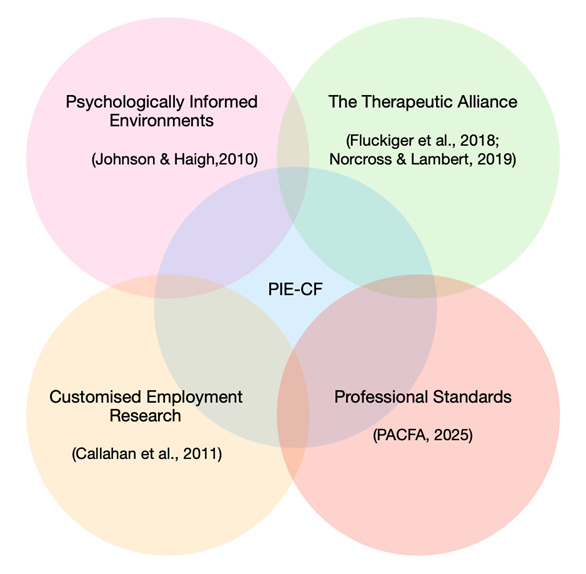
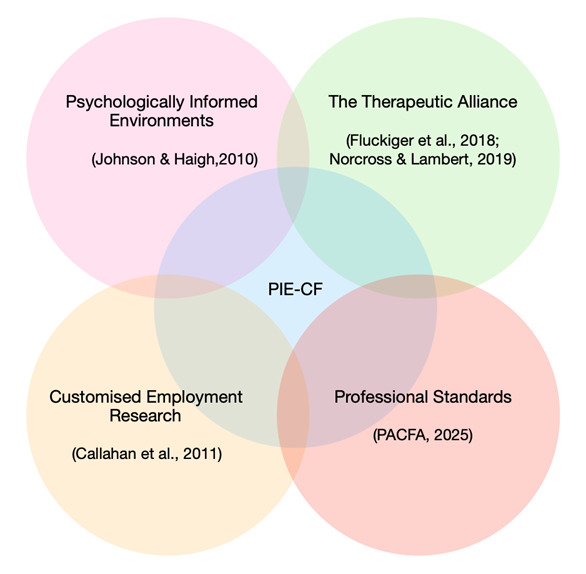
One key influence is the concept of psychologically informed environments (PIEs), developed within homelessness and complex needs services. PIEs embed psychological understanding into all aspects of service delivery, from environmental design to staff–client interactions, recognising that trust, safety, and emotional regulation are preconditions for meaningful change (Johnson & Haigh, 2010). This approach challenges the assumption that technical interventions alone are sufficient, reframing the relational climate as an active agent in client engagement and progress.
Within counselling research, the therapeutic alliance is consistently identified as one of the strongest predictors of positive outcomes. Conceptualised as a collaborative partnership characterised by shared goals, agreed therapeutic tasks, and the development of an interpersonal bond, the alliance demonstrates a reliable and clinically meaningful association with treatment outcomes across theoretical orientations and client populations (Flückiger et al., 2018; Norcross & Lambert, 2019). Meta-analytic evidence synthesising over 300 studies confirms that the strength of the alliance is directly associated with improved psychological and functional outcomes, with effect sizes comparable to or exceeding those of specific treatment techniques (Flückiger et al., 2018). This robust evidence base reinforces the PIE-CF’s emphasis on intentional relational practice as a determinant of success in employment contexts.
In the disability employment field, CE research has echoed these findings. Fidelity studies indicate that the correct technical execution of CE processes, such as discovery, job carving, and negotiation, cannot achieve optimal outcomes without a relationally attuned approach (Callahan et al., 2011). This mirrors the counselling literature, where technique and alliance function synergistically rather than in isolation (Norcross & Lambert, 2019).
The professional competencies articulated by PACFA (2025) provide an additional scaffold for the PIE-CF. The PACFA standards emphasise the creation of psychologically safe spaces, culturally responsive practice, ethical decision-making, and reflective practice. These align closely with the PIE-CF domains, embedding evidence-based counselling competencies within the specific operational realities of disability employment practice (see Figure 1).
Taken together, the literatures converge on a consistent conclusion: technical proficiency in employment services must be complemented by a psychologically informed, relationally grounded approach (Kregel et al., 2020). The PIE-CF operationalises this integration, providing a coherent framework that translates well-established counselling science into the context of CE. In doing so, it addresses a notable gap in the literature by offering a unified model that aligns professional counselling standards with evidence-based disability employment practice.
Method
Although this paper is conceptual, the PIE-CF did not emerge in isolation. The PIE-CF development followed a practice-based, iterative process that blended theoretical synthesis with applied professional experience (Smith & Pavlidis, 2026). The process is best described as a theoretical concept formation approach informed by lived professional practice, rather than an empirical study with experimental controls.
The development pathway included:
1. Literature Synthesis
An extensive, structured narrative review of research in counselling, trauma-informed care, neurodiversity-affirming practice, and vocational rehabilitation provided the theoretical building blocks for the PIE-CF. Researchers conducted searches across major academic databases, including PsycInfo, Scopus, and Google Scholar, using combinations of terms such as “therapeutic alliance”, “vocational counselling”, “customised employment”, “discovery”, “self-determination theory”, and “trauma-informed practice”. Priority was given to peer-reviewed empirical studies, meta-analyses, and foundational theoretical works with demonstrated relevance to employment counselling practice. The synthesis was iterative and theory-driven rather than exhaustive in a systematic review sense. Foundational contributions from Carl Rogers (1951) on person-centred therapy, Aaron Beck (1979) on cognitive frameworks, and William Miller and Stephen Rollnick (2013) on motivational interviewing informed the relational aspects of the model. In trauma-informed practice, Bessel van der Kolk’s (2015) emphasis on safety and emotional regulation shaped the conceptualisation of presence.
2. Competency Mapping
These theoretical insights were aligned with PACFA’s (2025) professional standards, ensuring the framework’s relational domains were grounded in nationally recognised ethical and competency-based practice. PACFA’s emphasis on cultural responsiveness, ethical decision-making, and the therapeutic alliance provided an explicit link between the counselling profession’s core values and employment counselling.
3. Practice Integration
The emerging domains of presence, inquiry, and engagement were integrated into CE service delivery across varied disability contexts. This step allowed for testing the adaptability of the model in neurodiversity-affirming environments, psychosocial disability support, and physical disability employment pathways. The work of CE pioneers such as Griffin et al. (2007) influenced the application of discovery-based inquiry methods.
4. Reflective Supervision
Practitioner experiences were critically reviewed through reflective supervision and peer dialogue. This step drew from the reflective practice traditions of Donald Schön (1992), ensuring that the model evolved in response to practitioner insights and challenges encountered in real-world contexts.
5. Case-Based Illustration
Anonymised participant narratives, such as those of “Ella” and “Mark” (see below), were used to demonstrate the application of the PIE-CF’s domains in practice. These vignettes illustrate how the theoretical constructs manifest in lived experience, supported by evidence from vocational rehabilitation research showing that relational quality affects employment retention (Borg & Davidson, 2008; Lysaght et al., 2012).
By integrating the contributions of theorists and practitioners from both counselling and employment fields, the PIE-CF emerges as a hybrid model, anchored in theory, validated through practice, and adaptable to diverse disability contexts.
Theoretical Foundations
The PIE-CF rests on three interdependent domains—presence, inquiry, and engagement—that together form the relational backbone of CE practice. Each domain draws from established psychological theories and counselling modalities, adapted to the unique demands of vocational support for people with disabilities. Importantly, these domains are not discrete, sequential steps but mutually reinforcing processes that, when integrated, create the conditions for trust, exploration, and sustainable action.
Presence
Presence refers to the counsellor’s capacity to establish an emotionally safe, attuned, and accepting relational environment in which participants feel genuinely seen, heard, and valued (Elliott et al., 2018; Rogers, 1951, 1961). It extends beyond physical proximity to encompass an embodied relational stance characterised by emotional regulation, congruence, and deep listening (Malet et al., 2022). Within the PIE-CF, presence is not treated as a personal trait but as a disciplined relational practice enacted moment by moment in response to the participant’s evolving experience.
The concept is grounded in Rogers’ client-centred theory, which identified empathy, unconditional positive regard, and congruence as core conditions for effective helping relationships (Rogers, 1951, 1961). Contemporary research continues to affirm the centrality of these relational qualities. Empathic attunement and authenticity have been shown to significantly predict client satisfaction, perceived benefit, and engagement across counselling and vocational contexts (Elliott et al., 2018; Murphy et al., 2013). When empathy, acceptance, and congruence are experienced as consistently present, satisfaction and perceived benefit increase; when absent, particularly through incongruence, trust and engagement diminish (Elliott et al., 2018). Presence therefore functions as a stabilising relational condition that reduces defensiveness and supports psychological safety within vocational exploration.
Whalen (2013) extends this understanding by conceptualising presence as embodied and co-regulated. Within this relational field, counsellor and participant mutually influence one another, supporting what Rogers (1959) described as organismic congruence, a felt alignment between internal experience and outward behaviour. In practice, such grounded presence enables the holding of a participant’s experience in the sense articulated by Winnicott (1960), containing emotional intensity without premature direction or judgement. This containment allows anxiety to settle and reflective capacity to expand, creating space for authentic vocational articulation rather than compliance.
Presence also aligns with self-determination theory (Deci & Ryan, 2000; Ryan & Deci, 2006) and its humanistic elaboration (DeRobertis & Bland, 2018). Within this framework, presence can be understood as an autonomy-supportive stance that nurtures the psychological needs of autonomy, competence, and relatedness. Non-controlling attunement refers to the counsellor’s capacity to remain emotionally responsive while deliberately avoiding directive pressure or premature shaping of vocational goals. Under such conditions, vocational aspirations are more likely to be internalised as self-endorsed, strengthening intrinsic motivation and fostering self-authorship. In this sense, presence reflects Rogers’ actualising tendency, whereby growth and fulfilment emerge in environments marked by empathy, acceptance, and authenticity (DeRobertis & Bland, 2018; Rogers, 1961).
While related traditions such as acceptance and commitment therapy (Dindo et al., 2017) and attachment theory (Mikulincer & Shaver, 2017) similarly emphasise mindful awareness and secure relational bonds, the PIE-CF does not import these models wholesale. Rather, it draws on their convergent insight that sustained vocational development depends upon a relational environment characterised by safety, attunement, and psychological coherence. Presence therefore establishes the conditions necessary for inquiry. Without this relational foundation, deeper exploration of vocational identity risks becoming procedural, defensive, or retraumatising.
Inquiry
Inquiry builds on the safety established through presence to initiate a structured and compassionate exploration of vocational identity. It moves beyond identifying surface-level job interests to examine the meanings, values, and narratives that shape an individual’s working life. This collaborative exploration reflects constructivist approaches to career development, which conceptualise vocational choice as an evolving identity project rather than simply matching traits to roles (Savickas, 2012).
Drawing on narrative therapy principles (White & Epston, 1990) and constructivist career theory (Savickas, 2012), inquiry invites participants to re-author dominant stories of deficit or limitation into accounts of capability, resilience, and growth. Empirical research in vocational counselling demonstrates that narrative approaches strengthen self-efficacy, enhance career adaptability, and deepen agency (Maree, 2013).
Strengths-based frameworks (Saleebey, 2006) support this re-authoring process by ensuring that abilities, resources, and coping strategies are explicitly identified and valued. In disability employment contexts, such approaches are associated with increased engagement and improved outcomes (Wehmeyer et al., 2017), particularly where they counter internalised stigma and expand perceived possibility. When conducted within an autonomy-supportive stance consistent with self-determination theory (Deci & Ryan, 2000), strengths exploration reinforces intrinsic motivation and consolidates emerging vocational direction.
Inquiry also remains attentive to relational and systemic influences on career development. Blustein (2011) highlights how internalised expectations and relational dynamics shape vocational imagination, while the systems theory framework situates career development within interacting personal and environmental systems (Arthur & McMahon, 2005). Rather than layering theory, the PIE-CF integrates these perspectives pragmatically, ensuring that vocational planning reflects both personal meaning and contextual reality.
In practical terms, inquiry clarifies preferred tasks alongside values, sensory needs, and environmental conditions necessary for sustainable employment. Person–environment fit theory (Kristof-Brown et al., 2005) and the theory of work adjustment (Dawis & Lofquist, 1984) reinforce that congruence between individual characteristics and workplace environments predicts retention and wellbeing. This integrative clarity provides the foundation for engagement, where insight is translated into sustained vocational action.
Engagement
Engagement operationalises the insights generated through inquiry into structured, values-aligned action toward meaningful workplace integration. It represents the sustained collaborative work of translating vocational self-knowledge into practice while protecting the integrity of the participant’s needs and aspirations. Engagement is therefore not a discrete intervention but an ongoing relational process in which plans are implemented, reviewed, and adapted as circumstances evolve (Savickas, 2012; Schön, 1992).
Drawing on motivational interviewing (Miller & Rollnick, 2013), engagement strengthens intrinsic motivation through collaborative dialogue that elicits commitment rather than imposes direction. Behavioural activation principles (Jacobson et al., 2001) support gradual, goal-directed participation in confidence and skill-building tasks, reducing avoidance and reinforcing mastery. Self-determination theory further ensures that actions remain autonomy-supportive and competence-enhancing, preserving self-direction within forward movement (Deci & Ryan, 2000; DeRobertis & Bland, 2018).
In disability employment contexts, engagement extends beyond individual skill development to include structural advocacy and environmental negotiation. Securing workplace adjustments, embedding inclusive practices, and facilitating systemic accommodations are often essential to align organisational realities with participant needs (Fossey et al., 2017; Wehmeyer et al., 2017). Research in supported employment (Bond et al., 2020; Drake & Wallach, 2020) and CE (Christianson-Barker et al., 2025; Griffin et al., 2007) consistently identifies sustained practitioner–participant collaboration as a critical predictor of job success. Engagement therefore depends upon relational continuity, responsiveness, and mutual commitment.
Relational depth (Mearns & Cooper, 2005) and co-created momentum (Whalen, 2013) further underscore that vocational progress is not purely procedural but relationally mediated. Trust and mutual responsiveness remain central throughout the transition into work (Geller & Greenberg, 2012; Mikulincer & Shaver, 2017). Effective engagement adapts pacing, complexity, and strategy to the participant’s readiness and context (Arthur & McMahon, 2005), maintaining coherence between action and aspiration.
In practice, engagement involves breaking goals into sequenced steps such as workplace visits, networking, skills training, and informational interviews, each embedded within reflective feedback loops (Schön, 1992). This iterative structure preserves alignment between the evolving work environment and the participant’s needs and preferences (Kristof-Brown et al., 2005). Advocacy and employer liaison consolidate these gains, supporting long-term stability rather than short-term placement.
By conceptualising presence, inquiry, and engagement as interdependent, the PIE-CF frames employment counselling as a developmental partnership rather than a transactional service. This integration ensures that participants are supported from the first moments of trust-building, through deep exploration of vocational identity, to the sustained realisation of dignified and fulfilling employment.
The Role of the Employment Counsellor
In the PIE-CF, the employment counsellor is the living embodiment of its principles. The counsellor does not simply facilitate job matches or broker placements; they hold the relational space in which presence, inquiry, and engagement unfold as an integrated and evolving process. The counsellor’s role is to walk alongside participants through the often unpredictable terrain of career development, supporting them as they navigate the emotional, cognitive, and practical challenges of finding and sustaining meaningful work.
The counsellor’s work is grounded in the understanding that sustainable employment outcomes do not emerge in isolation from the human relationships and social contexts in which they are pursued. The counsellor weaves together therapeutic rapport, vocational strategy, advocacy, and systemic navigation, recognising that each participant’s journey is shaped as much by their environment as by their skills or qualifications (Blustein, 2011; Lysaght et al., 2012). In doing so, the counsellor occupies a position that is at once profoundly personal and strategically systemic, engaging with the participant’s lived experience while negotiating the broader structural realities of the labour market, disability policy, and workplace culture.
The role is anchored in recognised counselling competencies that demand ethical integrity, trauma-informed practice, cultural responsiveness, and the integration of evidence-based methods (PACFA, 2025). These competencies provide the scaffolding for a practice that is both relationally attuned and strategically purposeful, enabling counsellors to address the practical demands of vocational change while remaining sensitive to the emotional and psychological currents that run beneath them.
In their daily practice, counsellors embody the attuned listening and empathic presence described in person-centred therapy (Rogers, 1951, 1957) and the deep, co-created connection of relational depth (Mearns & Cooper, 2005). This relational foundation makes it possible for participants to share their aspirations, uncertainties, and anxieties without fear of judgement, creating the trust necessary for meaningful vocational exploration. From there, counsellors draw on established employment models such as CE (Griffin et al., 2007) and Individual Placement and Support (Bond et al., 2020) to translate vocational identity into realistic and values-aligned opportunities.
However, the counsellor’s work does not stop at relationship building or job matching. They act as a constant point of stability in what can be a shifting and often fragmented support landscape, advocating for workplace accommodations, liaising with employers, and navigating program or funding requirements to safeguard the participant’s agency. This advocacy is not incidental; it is core to the role, ensuring that systemic barriers do not erode the progress made through relational and vocational work (Fossey et al., 2017).
Research in supported and customised employment has repeatedly shown that it is this ability to balance the cognitive pacing of the participant with the demands of the system that predicts both job retention and satisfaction (Inge et al., 2018). It is also what enables counsellors to bridge the gap between personal agency and environmental opportunity, fostering self-determination while actively working to dismantle structural barriers (Lysaght et al., 2012; Wehmeyer et al., 2017).
Ultimately, the employment counsellor in the PIE-CF model is both guide and ally; walking beside the participant as they move through the phases of presence, inquiry, and engagement. The counsellor keeps the participant’s vocational narrative at the centre while navigating the realities of the employment ecosystem, ensuring that each step forward is not only strategically sound but also deeply aligned with the participant’s identity, values, and long-term aspirations. This is not a role measured solely by short-term placement metrics; it is one defined by a commitment to the participant’s enduring vocational wellbeing, integration, and dignity.
Case Vignettes
These vignettes are based on actual clients and illustrate the PIE-CF in practice within the CE methodology.
Ella (Autism)
Ella’s journey into employment began with the recognition that conventional intake interviews and goal-setting sessions often overwhelmed her. Early sessions were held in a quiet library space, free from harsh lighting and auditory distractions, where the counsellor allowed for extended silences and mirrored Ella’s slow conversational pace. This intentional presence, grounded in sensory-aware and neurodiversity-affirming practice, appeared to help reduce anxiety while helping to establish a foundation of trust, aligning with evidence that psychological safety improves engagement for individuals with autism (Geller & Greenberg, 2012).
Notably, application of the PIE-CF has led to the development of a range of engagement tools, including the Sensory Comfort Mapping Tool (SCMT), which provides a structured, practice-informed method for identifying the psychological conditions that support sustained employment. Developed to strengthen the discovery process (Smith, 2025c), the SCMT shifts attention beyond task matching to the environmental, sensory, relational, and cognitive factors under which participation becomes psychologically sustainable. Rather than functioning as a diagnostic instrument, it facilitates collaborative interpretation of lived experience, enabling counsellor and participant to articulate the factors that stabilise attention, regulate distress, and sustain engagement.
Through inquiry, the counsellor invited Ella to describe her daily routines, preferred activities, and past experiences in structured environments. These narrative accounts were complemented by structured observation within familiar settings, consistent with discovery-based practice (Griffin et al., 2007). Storytelling enabled Ella to articulate experiences in her own language, while observational attention to task engagement, pacing, and environmental responses allowed the counsellor to identify patterns not immediately evident through direct questioning. Together, these methods revealed Ella’s strong affinity for detail-oriented tasks, such as cataloguing books and organising craft supplies, and her preference for predictable work patterns.
Engagement for Ella involved a gradual increase in exposure to potential workplaces, beginning with low-demand environments and progressing toward more complex settings. This graded approach is consistent with behavioural activation principles, which emphasise structured, incremental participation to build mastery and reduce avoidance (Jacobson et al., 2001). Within supported employment practice, progressive exposure to real-world settings has also been associated with increased confidence and vocational stability (Drake & Wallach, 2020). By pacing workplace engagement in alignment with Ella’s readiness and sensory profile, the process strengthened competence while preserving autonomy (Deci & Ryan, 2000).
Mark (Psychosocial Disability)
Mark’s entry point into CE was complicated by fluctuating mental health, past negative employment experiences, and long periods of social withdrawal. Early work with Mark focused on stabilising his daily routines and creating a consistent meeting schedule. The counsellor’s presence, characterised by reliability, non-judgement, and openness, appeared to counteract Mark’s fear of abandonment and reinforced his sense of safety, echoing evidence that relational continuity is critical in vocational rehabilitation for people with mental illness (Borg & Davidson, 2008).
During the inquiry, the counsellor explored Mark’s previous roles, noting his satisfaction when mentoring younger workers in a community garden project. Strengths-based questioning reframed his intermittent work history as evidence of resilience and adaptability. Discussions also identified triggers that could destabilise his mental health, allowing for proactive planning.
Engagement with Mark focused on co-designing a role that aligned with his peer support strengths and accommodated fluctuating energy levels. This involved negotiating with a local community centre for flexible hours and embedding wellness planning into his work routine. The counsellor also worked with the employer to address stigma, providing education on psychosocial disability and recovery-oriented practice. The outcome was a part-time peer mentor role where Mark thrived, reporting improved self-esteem, expanded social networks, and reduced hospital admissions. Evidence supports that such tailored roles improve both employment stability and overall wellbeing in this disability type (Drake & Wallach, 2020).
These vignettes demonstrate how the PIE-CF’s domains adapt to diverse disability contexts, translating relational foundations into measurable vocational and psychosocial outcomes.
Evidence Base for the PIE-CF Domains in Practice
The three relational domains of the PIE-CF are supported by empirical research across counselling and employment literature. Alliance studies link relational quality to positive outcomes (Elliott et al., 2018; Murphy et al., 2013), narrative career research affirms identity-based exploration (Maree, 2013; Savickas, 2012), and supported employment evidence highlights the importance of sustained practitioner–participant collaboration (Drake & Wallach, 2020; Griffin et al., 2007). The cases of Ella and Mark demonstrate how these principles translate into practice.
As outlined earlier, presence builds safety and trust; here we highlight the empirical evidence that supports its role in job retention and participant engagement. In Ella’s case, presence involved sensory-aware pacing that fostered an autonomy-supportive climate, encouraging open communication without fear of judgement (Deci & Ryan, 2000; DeRobertis & Bland, 2018). For Mark, it meant reliability and emotional steadiness, countering fears of abandonment and establishing a secure base from which he could engage in vocational exploration; an outcome consistent with attachment theory’s emphasis on secure relational bonds as a precursor to change (Mikulincer & Shaver, 2017). These applications align with person-centred therapy’s core conditions for growth (Rogers, 1961) and self-determination theory’s assertion that meeting needs for autonomy, competence, and relatedness enhances intrinsic motivation (Ryan & Deci, 2006).
In Ella’s process, inquiry revealed a preference for structured, detail-oriented tasks that matched her sensory and cognitive strengths. At the same time, for Mark, it uncovered an aptitude for peer support and mentoring. Both cases illustrate how inquiry, when grounded in strengths-based frameworks (Saleebey, 2006) and psychodynamic awareness (Blustein, 2011), moves beyond superficial assessments to build vocational identities that are both authentic and sustainable. This mirrors findings in disability employment research that strengths-focused, autonomy-supportive approaches improve engagement and long-term outcomes (Wehmeyer et al., 2017).
For Ella, engagement took the form of paced, supported workplace exposure and proactive advocacy for sensory-friendly adjustments. For Mark, it involved co-designing a flexible role, embedding wellness strategies, and actively addressing employer stigma. In both cases, engagement operationalised vocational identity through concrete actions: sequenced steps, negotiated accommodations, and sustained follow-up, that ensured alignment between the person’s needs and the work environment (Kristof-Brown et al., 2005).
By grounding these domains in robust theoretical foundations and established evidence-based practice, the PIE-CF ensures that employment counselling within CE is not only technically competent but also relationally robust. The journeys of Ella and Mark show how the interplay of presence, inquiry, and engagement, as supported by research in the therapeutic alliance and disability employment, can transform employment from a transactional service into an intensely collaborative, person-centred process that fosters long-term vocational wellbeing.
Discussion
The integration of presence, inquiry, and engagement within the PIE-CF provides a structured yet adaptable relational model for CE (Callahan et al., 2011; Inge et al., 2018). The PIE-CF’s strength lies in applying these domains flexibly to diverse disability contexts while maintaining consistent theoretical and ethical underpinnings (PACFA, 2025).
As the case examples illustrate, adaptation might involve sensory accommodations and paced communication for neurodiverse participants (Geller & Greenberg, 2012; Malet et al., 2022), or relational constancy and flexibility for those with psychosocial disability (Borg & Davidson, 2008; Fossey et al., 2017). These tailored applications reinforce that relational safety is a prerequisite for sustained vocational engagement (Mikulincer & Shaver, 2017; Van der Kolk, 2015).
Crucially, the PIE-CF shifts vocational assessment from a static, tool-driven process to a co-constructed exploration of identity, values, and environmental needs (Maree, 2013; Savickas, 2012), ensuring that job development is grounded in the participant’s lived reality. Engagement then ensures that these insights are translated into action through sustained collaboration, advocacy, and employer liaison (Bond et al., 2020; Wehmeyer et al., 2017).
By embedding recognised counselling competencies within CE, the PIE-CF provides a shared relational language for multidisciplinary teams, enabling more cohesive and psychologically informed employment support (Blustein, 2011; PACFA, 2025). However, systemic challenges persist. Funding models that prioritise short-term outputs can undermine the relational pacing central to the PIE-CF, and pressure to meet milestones risks premature placements. Addressing these barriers will require policy and funding reforms that value process alongside measurable outcomes (Drake & Wallach, 2020; Fossey et al., 2017).
Implications for Practice and Policy
Recognition of employment counsellors as a distinct profession under NDIS guidelines would validate the specialised relational and psychological skill set required for this role, ensuring appropriate remuneration and professional development pathways. Embedding the PIE-CF within the Customised Employment Quality Assurance Framework (CEQAF) and the Customised Employment Organisational Fidelity & Elevating Capacity Tool (CEOFECT) would strengthen relational fidelity in CE service delivery by operationalising counselling competencies within structured organisational quality systems (Smith, 2025a, 2025b).
Adjusting funding structures to allow trauma-informed and neurodiversity-affirming pacing would enable practitioners to work at the participant’s readiness without financial penalty, ultimately improving job retention and wellbeing. Promoting multidisciplinary integration would ensure PIE-CF-trained employment counsellors operate effectively alongside other allied health and employment specialists, bridging gaps between vocational and psychosocial supports. By embracing these measures, policy makers and service providers can move toward a person-centred disability employment system that balances accountability with relational integrity.
Conclusion
Developed by Dr. Peter Smith and colleagues at the Centre for Disability Employment Research and Practice (CDERP), the PIE-CF bridges CE and professional counselling practice. It recognises that supporting people with disabilities into meaningful work is not merely a technical exercise in job matching, but a complex, relational process requiring psychological safety, cultural responsiveness, and sustained collaboration.
By embedding nationally recognised counselling competencies within CE, the PIE-CF offers a framework that is adaptable across disability types and grounded in person-centred values, trauma-informed care, and neurodiversity-affirming practice. This integration supports employment pathways that are achievable, durable, and aligned with individual aspirations and wellbeing.
The cases of Ella and Mark demonstrate how the domains of presence, inquiry, and engagement, when practised with fidelity, can transform employment counselling from a transactional service into a process of identity-building, empowerment, and systemic advocacy. Yet systemic constraints, especially output-driven funding models, remain a barrier to applying this approach at scale.
Looking ahead, the PIE-CF has the potential to become a cornerstone of Australian disability employment policy and practice. To realise this, investment is needed in training, research, and policy reform that value relational integrity alongside measurable outcomes. By doing so, the sector can move toward a future where every person, regardless of disability, can pursue dignified, meaningful work within a supportive, psychologically informed environment.