
This article explores the potential benefits of WATT (walk and talk therapy) for both experienced practitioners and those new to counselling. Emerging in the 1990s, WATT is described as a modality in which the counsellor facilitates a therapy session in nature, walking side-by-side with the client (Slocum, 2024; Udler, 2023). While some suggest WATT is a distinct therapeutic modality (Clark, 2019; Dickmeyer et al., 2025; Prince-Llewellyn & McCarthy, 2025), many practitioners concur that WATT can be integrated into any counselling modality (Cooley et al., 2020; The British Psychological Society, 2020). Proponents of this modality have reported benefits to the client, including improving wellbeing and mental health while decreasing symptoms of stress (van den Berg & Beute, 2021). However, this article explores WATT’s potential benefits for the counsellor, guided by the following research question: “Can the therapist improve their wellbeing and decrease the prevalence of stress and burnout within the profession by practising WATT?” This guiding question aligns with recent scholarly interest in therapist self-care.
Our study adopted a qualitative approach, evidenced by its reliance on mainly qualitatively oriented studies (for example, narrative inquiry, grounded theory, and case studies) that have gathered data through interviews, observations, and narrative accounts of therapists’ experiences. The core analytic work involved constructing themes about how counsellors experience WATT (e.g., in relation to wellbeing, burnout, and professional skills) and interpreting these themes within their practice context, which is typical of qualitative research.
Specifically, the study performed a scoping review to identify and synthesise available evidence through a literature review using thematic analysis, a widely used qualitative data analysis method (Kiger & Varpio, 2020). Researchers prefer scoping reviews in the absence of available systematic literature reviews, or when concepts and ideas require further testing (Munn et al., 2018; Peters et al., 2021).
Primarily, this scoping review asked: “What are the reported benefits to the counsellor who uses walk and talk therapy?” It also asked whether these benefits could potentially include increased counsellor wellbeing, and in turn, whether improved counsellor wellbeing could subsequently increase longevity in the profession through decreased stress and prevalence of burnout. Overall, the value of this research lies in shifting the focus from client-only outcomes to a more holistic understanding of therapeutic practices that sustain and support the practitioners themselves.
Literature Review
Counsellor Wellbeing
Counsellors face a higher risk of burnout than some other professions because of the caring nature of the role (Duncan & Pond, 2024; Vivolo et al., 2024). Caring professions involve advocacy for clients’ psychological wellbeing alongside frequent exposure to clients’ narratives of distress (Davies et al., 2022; Vivolo et al., 2024). For instance, Suri et al. (2020) found a positive correlation between burnout and psychological distress.
Burnout
Burnout negatively affects the counsellor’s executive functioning, memory, attention, and cognitive performance; this leads to reduced productivity, poor feelings of personal accomplishment, reduced motivation, increased feelings of disappointment arising from failure to meet personal expectations, and increased feelings of hostility towards clients and colleagues (Davies et al., 2022; Vivolo et al., 2024). Further, burnout negatively affects the workplace through decreased therapeutic success, increased absenteeism, and high staff turnover (Davies et al., 2022; Vivolo et al., 2024).
According to recent research, the risk of burnout decreases as the wellbeing of the counsellor improves (Bali-Mahomed et al., 2022; Van Hoy & Rzeszutek, 2022). Within the current literature, psychological wellbeing refers to the integration of physical, psychological, spiritual, and social development, enabling individuals to live to their potential through pleasure and accomplishment (Bali-Mahomed et al., 2022; Voon et al., 2022). Counsellors with high psychological wellbeing maintain a positive self-image, demonstrate self-compassion, and experience greater happiness while demonstrating the capacity to regulate negative emotions. This psychological strength is associated with higher job satisfaction and overall quality of life (Bali-Mahomed et al., 2022; Van Hoy & Rzeszutek, 2022). It is therefore argued that promoting wellbeing enhances counselling practice in the instance that wellbeing is understood to encompass multifaceted embodied elements. Further, this process manages the specific risk factors facing the counsellor, such as the sedentary nature of office-based talk-only therapies. WATT can provide counsellors with an approach that promotes health and wellbeing, both for the client and for themselves.
Walk and Talk Therapy
As a counselling modality, WATT integrates physical activity in nature with a therapy session (Clark, 2019; Revell & McLeod, 2017; Slocum, 2024). WATT enables the counsellor to conduct therapy outside the counselling room, thereby interrupting the unhealthy sedentary workday commonly experienced in the profession (Hawryliw, 2017). The counsellor and client walk side-by-side at a pace that is comfortable for the client. Current research indicates that nature and movement can have a positive impact on the therapeutic process and the counsellor–client relationship (Clark, 2019; Cooley et al., 2020; Naor & Mayseless, 2021; Revell & McLeod, 2017).
The client receives numerous physical and psychological benefits from attending a WATT session—a consequence of engaging in physical activity (Clark, 2019; Cooley et al., 2020; Revell & McLeod, 2017). Specifically, as noted by Greenleaf et al. (2024), physical activity increases blood flow to the brain, optimising brain functioning and improving mental health capabilities by stimulating cognitive processes. Physical activity triggers the release of neurochemicals, such as dopamine, norepinephrine, serotonin, and endorphins, which change the client’s blood chemistry. These changes produce a euphoric sensation, stimulate body relaxation, target mood regulation and stabilisation, and decrease the effects of stress and anxiety. Further, several researchers have observed enhanced psychological processing, improved mood, improved problem-solving skills, and conversational flow among clients engaged in the modality (Clark, 2019; Greenleaf et al., 2024; Prince-Llewellyn & McCarthy, 2025; Revell & McLeod, 2017).
The client’s experience of the benefits of doing physical exercise has been well documented through the lens of both the counsellor and the client (Carrico, 2018; Clark, 2019; Cooley et al., 2020; Revell, 2019; Walker, 2023); however, the literature has rarely discussed any benefits to the counsellor. Yet, it is highly plausible that counsellors who regularly conduct WATT would experience health benefits themselves since they participate in the same light-to-moderate physical activity that is known to enhance physical and psychological health in adults (Warburton et al., 2006; World Health Organization, 2024). This suggests that counsellor wellbeing may improve, the prevalence of occupational stress and burnout in counsellors may decrease, and longevity in the counselling field may be enhanced by promoting the benefits of WATT to both counsellors and clients. The most common counsellor benefits identified in the literature include decreasing a sedentary lifestyle, increasing time spent outside, growing connections to nature, and experiencing improvements in physical and mental health, as well as overall wellbeing (Carrico, 2018; Revell, 2019; Slocum, 2024; Walker, 2023). While these benefits resonate with the anecdotal experience of WATT practitioners, they also prompt more extensive investigation, which has led to this scoping review.
Method
Database Search
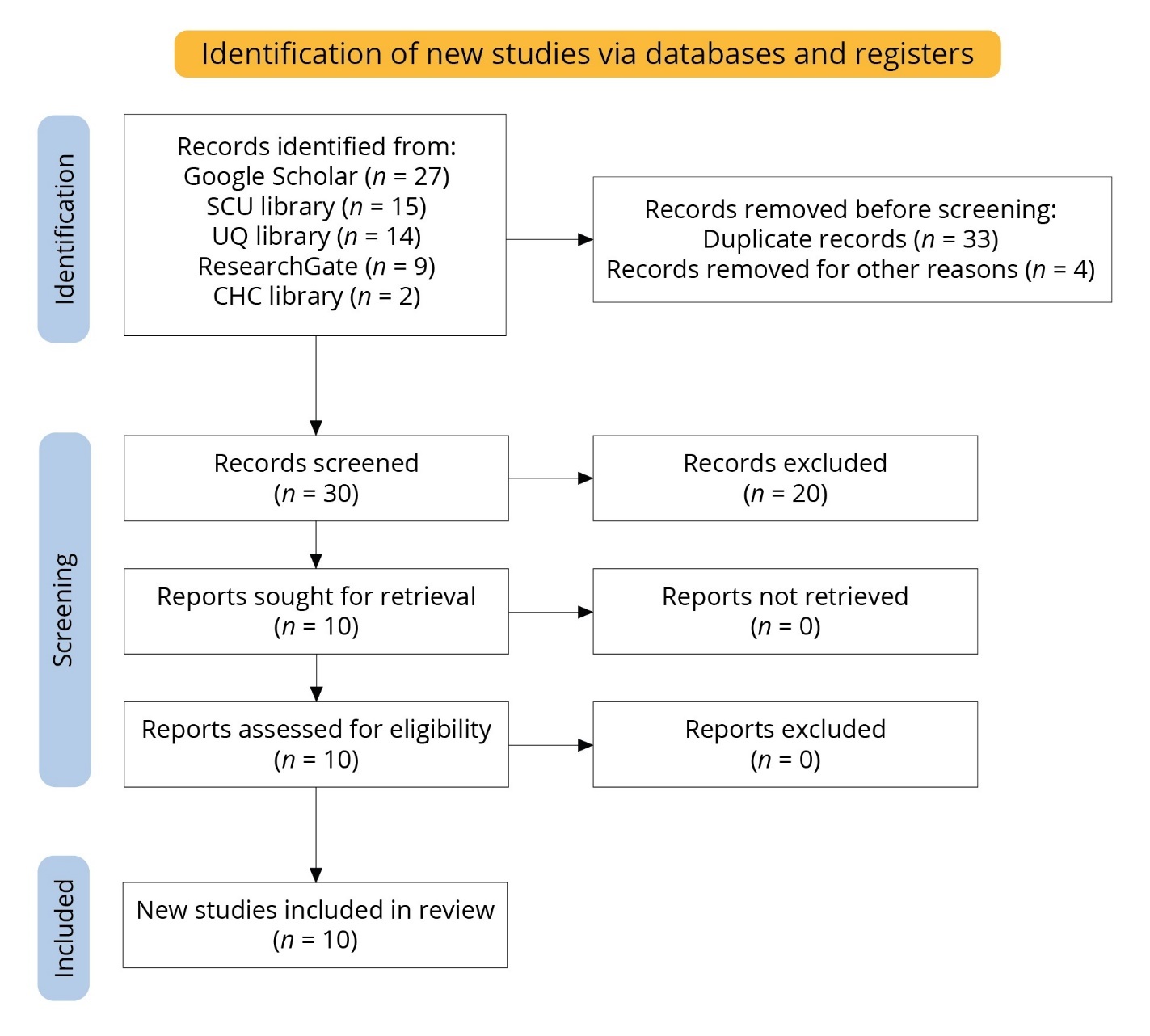
An initial literature search revealed that no scoping reviews existed for exploring mutualism in WATT. In this article, mutualism is used in the broadest sense to describe a reciprocal relationship in the context of behavioural science and counselling, whereby both the client and the counsellor benefit from the interaction. The Preferred Reporting Items for Systematic reviews and Meta-Analyses for Scoping Reviews (PRISMA-ScR; Haddaway et al., 2022) and Munn et al.'s (2018) guidelines were used to provide structure and reliability for the study. The scope of this literature review included research published from 2011 to 2024. The research was refined to full-text papers written in English. Five electronic platforms were searched: Google Scholar, ResearchGate, Southern Cross University library, The University of Queensland library, and Christian Heritage College library (see Appendix A). Search terms included “benefits to the therapist with WATT”, “benefits to the counsellor with WATT”, and “benefits to the psychotherapist with WATT”. Records were excluded if the title contained “group sessions” or “group therapy” since these types of intervention are significantly different. After initial screening, a total of 30 papers comprising a mixture of peer-reviewed studies and grey literature remained. Twenty papers were excluded owing to a lack of relevance to the topic. The online search resulted in 10 papers that referenced the counsellor’s experience of WATT and specifically reported benefits for the therapist (see Figure 1).
The available literature used the following terms interchangeably: nature, green spaces, environment, outside, and outdoors. Moreover, the literature did not differentiate between walking, physical activity, movement, and activity. This article preserves this lack of differentiation for each set of terms; however, further research may benefit from differentiating these terms to minimise confusion as the empirical evidence for WATT grows.
Findings and Discussion
Overview of the Articles
While none of the studies reviewed focused on the benefits to the counsellor who integrates WATT into their practice, they contained peripheral discussions of this topic and related issues (see Appendix B). Many articles shared the desire among practitioners to understand the client’s experience of WATT (Carrico, 2018; Clark, 2019; Cooley et al., 2020; McKinney, 2011; Revell, 2019; Slocum, 2024; Walker, 2023) or investigated the therapist’s perspective of the client’s therapeutic experience (Cooley et al., 2020; Revell, 2019; Slocum, 2024; Walker, 2023). Jordan (2013) and Lewis (2017) focused their research on the therapist’s experience of moving therapy outdoors. Although Charbonneau (2016) focused on the therapist’s experience when facilitating WATT, she did not explicitly explore the benefits to the therapist.
The literature reviewed predominantly used qualitative research designs. Jordan (2013) and Charbonneau (2016) employed narrative inquiry, while McKinney (2011) incorporated grounded theory, and Carrico (2018) presented a descriptive, multiple case study. Clark (2019), Jordan (2013), Lewis (2017), Slocum (2024), and Walker (2023) utilised exploratory and/or descriptive design. Variations included Revell (2019), who employed a mixed methods design, and Cooley et al. (2020), who conducted a meta-synthesis systematic review.
A diverse range of data collection and analysis methods was used across this research, consistent with qualitative design, and appropriately fitted to their respective research designs. Data collection methods comprised semi-structured interviews (Carrico, 2018; Clark, 2019; Jordan, 2013; Lewis, 2017; McKinney, 2011; Revell, 2019; Walker, 2023), online questionnaires (Revell, 2019; Slocum, 2024), field conversations (Charbonneau, 2016), audio recordings (Clark, 2019), observations (McKinney, 2011), and article searches (Cooley et al., 2020; McKinney, 2011). The data analysis methods used comprised holistic coding (Carrico, 2018), three-stage coding (McKinney, 2011), thematic analysis (Carrico, 2018; Cooley et al., 2020; Lewis, 2017; Revell, 2019), narrative consolidation (Charbonneau, 2016), interpretative phenomenological analysis (Clark, 2019; Walker, 2023), meaning generation (Jordan, 2013), descriptive statistics (Revell, 2019; Slocum, 2024), inferential statistics (Revell, 2019), and Statistical Package for the Social Sciences and exploratory factor analysis (Slocum, 2024).
Benefits to the Counsellor Who Uses WATT
The scoping review identified a range of potential benefits to the counsellor who uses WATT in their practice and categorised them under five themes: (a) wellbeing, (b) physical health, (c) mental health, (d) being in nature, and (e) counselling skills.
Benefits to the Counsellor’s Wellbeing
The findings suggest that wellbeing improved while the risk of stress and burnout decreased among counsellors who integrated WATT sessions into their practice (Clark, 2019; Slocum, 2024). Charbonneau (2016) suggested counsellor wellbeing improved simply from exposure to nature. Revell (2019) attributed this improvement in counsellor wellbeing to the opportunity to be outdoors and engage in physical activity through walking during sessions with clients, which in turn decreased counsellor stress (Cooley et al., 2020; Jordan, 2013).
WATT can also help decrease the risk and prevalence of burnout among counsellors (Carrico, 2018; Charbonneau, 2016; Revell, 2019). The literature rationalised this by suggesting that WATT offers counsellors some control over their working environment, which leads to increased job satisfaction and feelings of professional competency (Revell, 2019).
Benefits to the Counsellor’s Physical Health
While ample research has demonstrated the general benefits of physical activity for the client engaged in WATT, the literature on how physical activity benefits the counsellor who uses WATT is surprisingly lacking. Yet, evidence for benefits to the counsellor is growing through brief mentions in the body of literature and its paratexts. Jordan (2013), McKinney (2011), Revell (2019), and Slocum (2024) briefly mentioned increased counsellor energy levels within their work. Slocum’s (2024) article was the only one to mention specifically in their findings that the counsellor reported increased energy after facilitating a WATT session with a client. Similarly, Jordan (2013) suggested that being in nature appeared to promote the counsellor’s fatigue recovery but did not explicitly state that the therapist experienced an increase in energy levels. Further, Revell (2019) specifically described walking as generating energy for those involved in the therapeutic process. McKinney (2011) suggested that the increased energy reported by the client could also occur for the therapist.
Despite being hidden within the available research, evidence for WATT benefiting the counsellor presents promising insights that may inspire further research and practice. For example, Cooley et al.'s (2020) is the only article that briefly mentions the biological changes that occur from physical activity, suggesting that the added movement in WATT can improve the counsellor’s quality of sleep, decrease body fat, decrease cholesterol levels, and reduce the risk of cardiovascular health issues. While it is reasonable to assume that the therapist may experience the same physiological benefits of walking as the client, scant evidence currently supports this conclusion within the literature. This disparity concerning the physiological experience of the counsellor during WATT sessions warrants further investigation. In particular, it is essential to determine whether the roles and responsibilities of the counsellor within the WATT session render these benefits less attainable for the counsellor than they are for the client.
Regardless of whether these specific benefits result for the counsellor, WATT sessions at least benefit the counsellor by interrupting the sedentary workday typical of therapy work. Charbonneau (2016), Clark (2019), Cooley et al. (2020), and Slocum (2024) all viewed WATT as one way to mitigate the adverse effects—such as a sedentary lifestyle—of conducting back-to-back therapy sessions within the counselling room because WATT essentially involves continuous walking in an outdoor setting. The walking pace requires neither high exertion nor physically challenging terrain, but bilateral bodily movement while immersed in the therapeutic process.
An existing body of evidence documents how movement in therapy activates the release of endorphins, improves cognitive processes, mirrors internal processes of self-awareness and problem-solving competency, increases clarity of thought, encourages creativity, and increases motivation for change (Revell, 2019; Slocum, 2024). While neither Revell nor Slocum specified either the client or therapist when exploring the association between movement and psychological changes, the counsellor may also reasonably expect to experience some of these benefits.
Benefits to the Counsellor’s Mental Health
This scoping review identified various potential mental health benefits for therapists (Charbonneau, 2016; Cooley et al., 2020; Jordan, 2013; Lewis, 2017; McKinney, 2011; Revell, 2019; Slocum, 2024). However, only Lewis (2017), McKinney (2011), and Revell (2019) explored these benefits further. Lewis (2017) stated that the counsellor found it easier to manage emotional regulation and somatic reactions within the session when facilitating WATT. Revell (2019) explored the concept of revitalisation, and McKinney (2011) identified improved mood as a benefit to the counsellor.
Further, Revell (2019) stated that counsellor revitalisation occurred through experiencing self differently in relation to the client during a WATT session. In Revell’s research, each WATT therapist commonly believed that walking in nature held restorative and healing power, suggesting that the potential for revitalisation latent in WATT could apply within the practice of counselling itself. This modality may reduce the energy investment from the counsellor for the use of self in counselling while also potentially offering a protective factor against burnout and increasing professional retention.
Counsellors reported that WATT provided mental health improvements for the client through reduced symptoms of anxiety, depression, and anger (Dickmeyer et al., 2025; McKinney, 2011). However, McKinney (2011) suggested that WATT potentially provides mental health benefits for the counsellor through improved mood. If facilitating WATT can improve the counsellor’s mood, this may mitigate the impact of hearing distressing stories from clients. Applying WATT to one or more daily sessions with clients could provide a protective factor against counsellor burnout, thereby enhancing practitioner wellbeing throughout the counsellor’s professional lifespan. Systematically, improved mood arising from WATT could positively influence retention rates and decrease stress and the risk of burnout.
The counsellor can also use WATT as an act of self-care (Carrico, 2018; Charbonneau, 2016; Cooley et al., 2020; McKinney, 2011; Revell, 2019). A counsellor’s mental health is susceptible to compassion fatigue, increased stress, and risk of burnout and leaving the counselling profession (McKinney, 2011). Self-care is associated with decreasing these mental health risk factors (Cooley et al., 2020; McKinney, 2011). Carrico (2018) suggested that stress decreases in the counsellor after they engage in the self-care activities that WATT provides; based on counsellor feedback, Carrico also suggested that counsellors can use WATT to promote self-care throughout the workday by engaging in self-care activities alongside the client during WATT sessions. Self-care activities during WATT sessions can include mindful meditation, movement, breath work, and photography (Carrico, 2018). Again, studies identified the walking component as a conduit for counsellor self-care (Cooley et al., 2020; McKinney, 2011). WATT also provides an opportunity for the counsellor to spend time after the session connecting with nature and utilising the environment for physical activity that can complement other holistic self-care strategies (Carrico, 2018).
Benefits of Being in Nature for the Counsellor
The literature associated being in and connecting with nature with a range of cognitive benefits, including increasing resilience within the counsellor (Slocum, 2024; Walker, 2023), as well as better mood, mental health, and wellbeing (McKinney, 2011). Further, Jordan (2013) investigated the therapist’s relationship to nature, concluding that nature provided a resource for restoration, healing, and leisure. Consistently with Jordan (2013), Charbonneau (2016) suggested that connecting to nature allowed the counsellor to access more of their “way of being” (p. 131) through the associated exercise and fresh air. This increased access to counsellors’ way of being positively describes how WATT promotes a different style of the use of self that might revitalise the counsellor. In practice, this may present through diminishing the counsellor–client power gradient and reducing the emotional burden on the counsellor compared with traditional therapeutic environments.
Conducting therapy in nature, where the client and counsellor walk side-by-side, can create a stronger sense of collaboration in the counsellor–client relationship. The position of the counsellor walking side-by-side with the client diminishes the spatial dynamics of a relational power differential, which commonly influences helping professionals’ relationship with clients. Lewis (2017) suggested that nature provides a “cohabited space” (p. 23) that can itself shoulder some of the emotional burden typically carried by the counsellor in the traditional counselling room (Revell, 2019; Slocum, 2024). While not directly benefiting the counsellor, this dynamic may lessen the burden of creating and holding space for the client.
Benefits to the Counsellor’s Professional Skills
The literature also identified themes based on refining therapeutic skills among the benefits for counsellors. The themes included the therapeutic relationship itself, presence, confidence, creativity, and congruency. By taking the relationship outdoors, the connection between counsellor and client is strengthened through the shared experience of being in nature (Clark, 2019; Cooley et al., 2020). The counsellor hopes to see the connection to the client grow, and their connection to nature and the wider world develop (Beaumont, 2023; Cooley et al., 2020). However, it is unclear whether the connection to the client resultant from sharing nature as a cohabited space precipitates a greater connection to nature, or vice versa. In either case, the counsellor’s sense of participation within a system larger than themselves most likely translates into increased awareness and presence within the therapy session.
Therapeutic presence also becomes easier for the counsellor. Participants in the study by Lewis (2017) expressed feeling more alive and present with the client when in nature; some participants stated feeling more embodied, conscious of body reactions, and less “stuck” (p. 73) in their thoughts. This tacit benefit of WATT enhancing therapeutic presence from being in nature can lighten the cognitive load on counsellors, especially early-career counsellors; if WATT encourages being present in the moment, the counsellor can utilise the natural integration of presence in WATT without intentionally focusing on building rapport, while also refining their counselling skills.
WATT can also benefit the counsellor through increasing confidence, resilience, and trust in the therapeutic use of self, skills, and self-disclosure (Cooley et al., 2020; Revell, 2019; Slocum, 2024; Walker, 2023). The notion of the counsellor growing in resilience suggests that as resilience increases, symptoms of burnout, compassion fatigue, and stress decrease. While Walker (2023) suggested this approach for the counsellor, his research primarily focuses on the adolescent client’s experience. Therapists who conducted therapy sessions outdoors recalled feeling improved clarity (Slocum, 2024), leading to increased confidence in self and skills; this confidence may prove especially valuable for early-career counsellors who are still embedding the practical execution of skills into their therapeutic repertoire. However, further research is needed to verify the connection between WATT and increased confidence in professional skills. If implemented more systematically within counselling practice, WATT could fast-track skill refinement for new counsellors or provide seasoned counsellors a boost in confidence after a difficult or negative client outcome. Thus, the connection between confidence and skill consolidation during WATT sessions offers potential for further application within counselling professional development.
Among the studies reviewed, only Cooley et al. (2020) identified creativity as a benefit for the counsellor using the WATT intervention. WATT provides literal space for creativity to flourish within the counsellor by engaging nature as a therapeutic aid. Nature contains objects that can be used for visual expression or as metaphors, which could decrease overreliance on strength cards as counselling resources and re-engage clients for whom traditional methods of therapy have exhausted their usefulness.
Interestingly, the literature suggests that WATT enhances the counsellor’s congruency, thereby enabling the counsellor to integrate personal beliefs and values (Revell, 2019; Slocum, 2024). Counsellors who use WATT tend to believe in the benefits of being outdoors and engaging in physical activity (Slocum, 2024). Given that Rogers (1957) offered modelling congruency as a component of his counselling theory, and WATT provides pathways for counsellors to practise congruency, this raises questions concerning WATT’s ability to increase longevity within the counselling field by promoting congruency and its subsequent value in the counselling profession.
Limitations
The research limitations of the studies reviewed include generalisability issues, positive response bias, researcher bias, and participant bias. Most articles analysed contained generalisability concerns (Carrico, 2018; Charbonneau, 2016; Lewis, 2017; Revell, 2019; Walker, 2023): using qualitative designs limited their ability to capture the diversity within and across populations because of their smaller sample sizes. The literature also suggested positive response bias as a limitation. This stemmed from using participants inclined towards using WATT who may already have integrated it into their current practice (Carrico, 2018; Cooley et al., 2020; McKinney, 2011; Slocum, 2024; Walker, 2023). Research bias arose from positive personal experience of WATT (Jordan, 2013; McKinney, 2011). Limited researcher experience was a concern for Lewis (2017), while participant bias was cited by McKinney (2011).
This scoping review did not identify conflicting arguments or disagreements within the literature regarding the benefits for the counsellor; however, it did highlight a key challenge in the existing literature: its limited scope and relevance to the counsellor experience. There is a definitive gap in the literature regarding the counsellor’s experience of the benefits of integrating WATT into clinical practice, exacerbated by the use of inconsistent terminology for exploring WATT. This review found that the literature lacked conceptualisation of the counsellor’s experience. The studies commonly identified the counsellor as the participant, yet they commented on counsellors’ perceptions of client experience. The literature demonstrates a gradual emergence of associations within WATT for improved wellbeing and increased longevity that can be applied within the counselling profession.
As stated above, terminology was at times ambiguous. The terms walking, physical activity, movement, and activity appeared interchangeably, as did nature, green spaces, environment, outside, and outdoors. This review overlooked this ambiguity because the body of research was limited.
Ethical Considerations and Practical Application
While this article reports a range of potential benefits for the counsellor who utilises WATT interventions, it has thus far not acknowledged its potential for misuse. The literature recognises that numerous factors influence a counsellor’s choice of modality to use with a client. Beutler et al. (2016) highlighted this by saying that “selecting the most appropriate treatment for each patient can be a nebulous and unreliable task, varying by the clinician’s biases and theoretical training and with uncertain or unmeasured result” (p. 100).
The choice of using a WATT intervention, as with any modality, is potentially safeguarded by compliance with the ethical standards of the profession. However, it could be argued that mutualism overemphasises therapist self-care, which contravenes the client focus of the helping professions. Because exploration of mutualism is scant in the literature, the term may be viewed with suspicion. While it may be uncomfortable for counsellors to discuss or acknowledge openly how utilising a WATT intervention benefits them, assuming that WATT compromises client care unreasonably overextends the argument against mutualism. Further, the helping professions are increasingly recognising the need for self-care among practitioners. Therefore, the potential for therapists to engage in counselling approaches that also benefit them could be considered an ethical responsibility within the profession.
The literature also raised several potential ethical concerns for practitioners utilising WATT. In short, these centre on the potential for blurring boundaries by the physical act of walking together outside and the increased risk of potential harm to either client or therapist through physical dangers, environmental factors, lack of informed consent, medical factors, and the chance of meeting social acquaintances, thus violating client privacy (Cooley et al., 2020; Moore & Mahmood, 2025). From both a practical and ethical perspective, counsellors should discuss these issues upfront with clients. Finally, as with any modality, WATT should be offered to the client without coercion, only by experienced and trained therapists, and only where it is valid as an appropriate treatment goal.
Future Research
This review highlights potential avenues for further research and practice considerations. Firstly, there is a need for clearer conceptual and ethical work on the term mutualism in counselling, including the development of a more precise definition and an understanding of how the term differs from reciprocity, dual relationships, and self-care. This development extends to understanding how clients perceive the ethics and nature of the benefits offered by the therapist during WATT.
Secondly, future research on WATT may benefit from refining key terms to decrease ambiguity, confusion, and misinterpretation. As WATT gains traction, clearer definitions would enhance understanding of the influence of each setting and how facilitating different activities (e.g., walking versus stretching) affects the counsellor’s experience.
Thirdly, the paper highlights the scarcity of therapist-focused empirical research. Future studies could place greater emphasis on the counsellors’ own experiences. This could include longitudinal studies examining any measurable changes that have occurred for counsellors utilising WATT in the domains of wellbeing, resilience, and general health, and whether these are associated with longevity, career decisions, and other factors.
Fourthly, future research could explore mutualism in other modalities that place a strong emphasis on the collaborative relationship between therapist and client (e.g., play therapy, cognitive behavioural therapy, acceptance and commitment therapy, narrative therapy, and expressive therapies).
Fifthly, there is a need for further research into the specific risk factors, equity, and other practical issues related to WATT. Studies could explore how clients perceive the ethics and nature of the potential benefits the therapist may receive in utilising WATT. Another gap in the current literature is examination of how therapists practically and ethically manage the limitations of client mobility and safety restrictions presented by WATT.
Conclusion
This scoping review investigated WATT’s potential benefits to the counsellors who practise the modality. Five themes emerged that support the assertion that counsellors utilising WATT can expect to experience benefits from the practice: improved wellbeing, physical health, mental health, connection to nature, and therapeutic skills. Specifically, potential physical and psychological benefits include increased energy and improved mood. The counsellors surveyed in the literature reported experiencing improved wellbeing by being in and connecting with nature, which strengthens the therapeutic relationship and the therapeutic skills of presence, confidence, creativity, and congruency during WATT sessions.
Subsequently, the literature suggests that improving the counsellor’s overall wellbeing may decrease stress and the risk of burnout. The WATT intervention thus contributes resources to the counselling profession itself, rendering it a pertinent topic for developing holistic counselling practice.
Finally, “each step counts” when it comes to talking therapy outdoors. This review has explicated the potential benefits to personal wellbeing that can be found outside the counselling room. While WATT initially requires set-up considerations and is not a viable option for every client, being in and connecting to nature provides long-term holistic benefits for the client and the counsellor; this connection can stimulate increased therapeutic presence and consolidate counselling skills. While the client may benefit from the therapy, therapists may also experience improved physical and mental health and tacitly build resilience against stress and burnout. Integrating WATT sessions into clinical practice might provide counsellors with a trail map to a long, successful counselling career, as well as opportunities to stop and enjoy the view.