
The stories we tell are vehicles of identity (Bruner, 1990). Likewise, the practice of values-oriented action and social connection, that is, how we are in relationship with one another and other beings, fits within our webs of meaning (White, 2004a). This article traces the relationship practices of a counsellor, a program participant, and a program horse named Rain while providing an account of a practice innovation project completed for a Master of Narrative Therapy and Community Work. I locate the story development and enrichment of personal agency within contemporary literature and trace the migrations of identity for both participant and practitioner while reflecting on my access to social power and unearned privilege[1].
Professional Context for Practice Innovations
The professional context of the innovation project was the Horses for Hope program which operated from a property on Yorta Yorta and Bangerang Country in Mooroopna North, Victoria, Australia. The Horses for Hope program (now closed owing to economic and personnel constraints) combined the pre-training of horses who had experienced harm with narrative practices (Epston, 2011). Horses fostered to the program worked with participants who supported the horses’ development of skills and trust of humans. Horses graduated from the program and left the property when they were ready for a level of training not covered by the program (being ridden), and new horses were then welcomed. These practices with equines fostered a context in which human participants contributed to the collaborative care and support of program horses. Participants were guided by staff, of which I was a paid member, to enact particular relational practices with horses (Hutton & Emonson, 2015). Sessions with a participant comprised three sections: counselling, horse work, and counselling. Within a discursive framework of contribution, counselling discussions took place informed by the principles of narrative therapy (NT; White, 2007). The innovation builds on the 20-year history of Horses for Hope (Epston, 2011; Hutton & Emonson, 2015; Nelson et al., 2016) and was informed by a rapid scoping review (RSR).
Method
Rapid Scoping Review
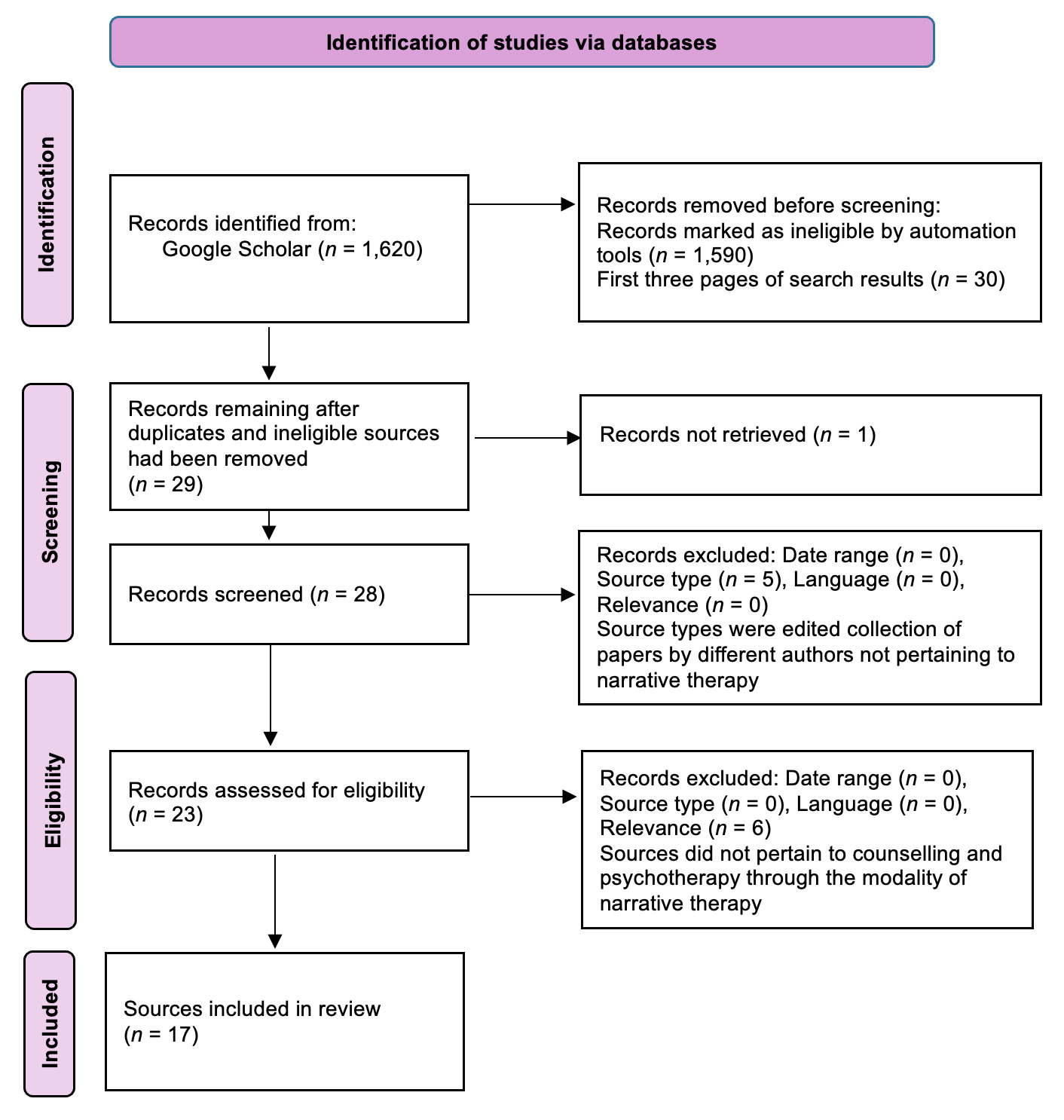
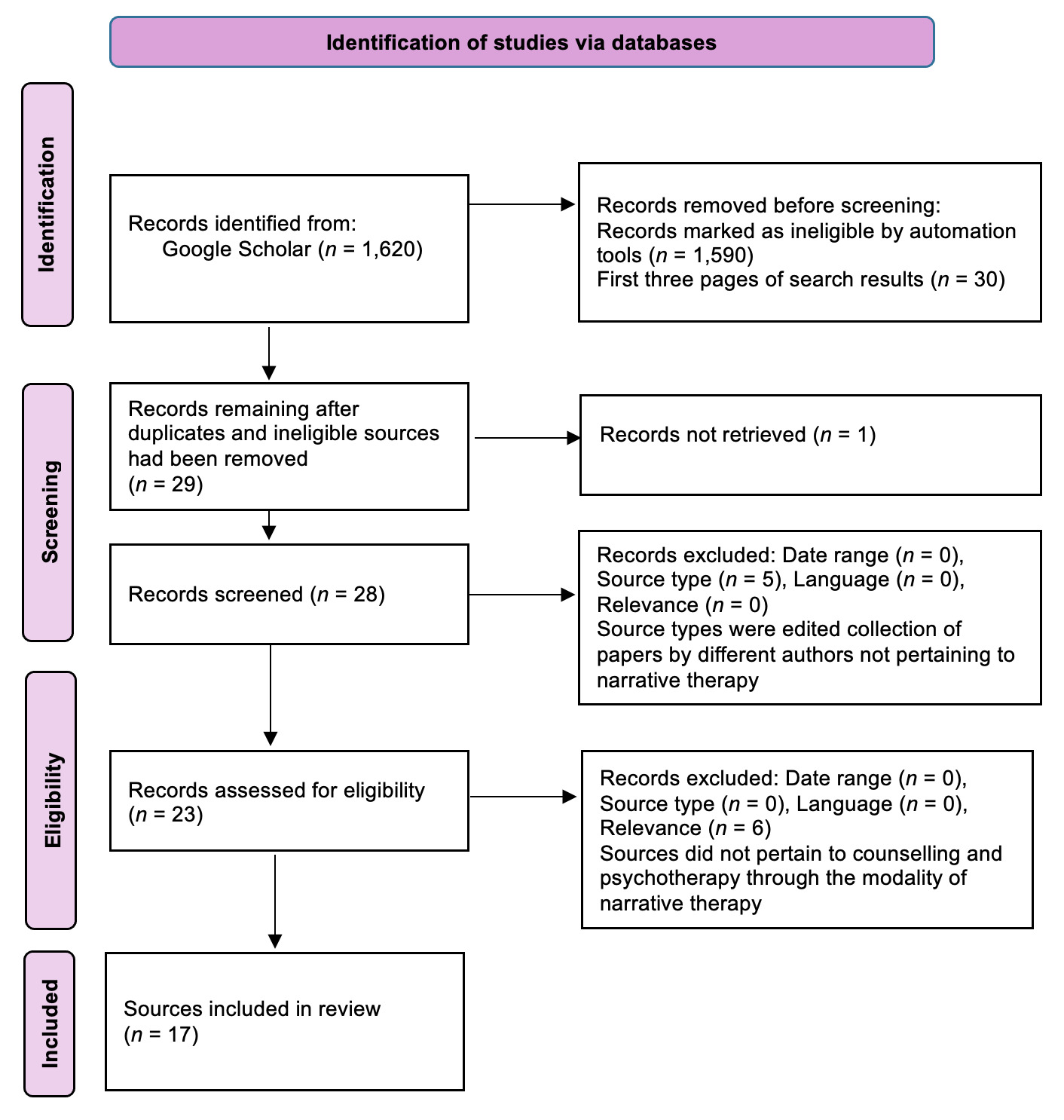
This study conducted a RSR to map published literature on how NT has been used in relation to horses, guided by the question: What has been published about narrative therapy and horses? The rapid approach to a scoping review was selected to enable a timely synthesis. The review included streamlined steps: using a single database (Google Scholar); limiting screening to the first three pages of results; excluding grey literature; restricting literature to English language-only sources; defining a date range (1990–September 2024); including peer-reviewed articles, books, and dissertations; and extracting single-reviewer screening and data. The search terms used were “horse” OR “equine” AND “narrative therapy”, and methodological consultation occurred with Dr. Claire Nettle. See Table 1.
As outlined in the PRISMA flowchart presented in Figure 1, the screening process identified 1,620 records. Of the 29 records screened, one could not be retrieved, five were removed owing to source type, and an additional six were removed owing to relevance, leaving 17 records that met the inclusion criteria. Full screening details are provided in Figure 1.
Horse Work as a Context for Preferred Stories
The practice of NT entails rich story-making. Accordingly, the stories of horse work provide different contexts of meaning to respond to the ongoing developments of life beyond the round yard, that is, life outside therapy. NT works from the metaphor that life is read like a book, or put another way, stories constitute identity and provide intelligibility when making meaning of the plethora of everyday occurrences (White, 2007).
Within the metaphor of narrative (White & Epston, 1990), the experience of horse work is understood as lived events that provide material from which stories are composed, a primary source of experience—original and immediate. In counselling discussions, participants re-tell events first-hand, practitioners record and reflect on these accounts, and special others witness the accounts. Guided by a witnessing structure, practitioners facilitate the process, consult participants, and interview special others, thereby allowing participants to authenticate preferred identity claims (Freedman, 2014). With horse work functioning as the material informing the primary source of preferred identity, tales of the round yard are storied, enabling people to become more “narratively resourced” (White, 2004a, p. 90). Collaboratively, the accounts of horse work are re-told, analysed, re-viewed, and negotiated in their relationship to the person’s life. In this way, the retelling involves contextualising and recontextualising the multi-faceted horse work experiences to sponsor a dramatic engagement with the text of one’s life.
The co-authored session notes (written collaboratively) become the official record of the session and a primary source of preferred narratives, informed by the words of those present (Newman, 2008). This method contrasts with biomedicalised record-keeping practices and their associated, highly differentiated power relations. Here, I introduce Kenna and our shared work towards preferred stories.
Ethical and Program Participant Context
The participant featured in this practice reflection has been de-identified and is referred to using the pseudonym Kenna. Signed written consent was obtained from Kenna as part of the University of Melbourne/Dulwich Centre studies and service engagement at Horses for Hope Ltd. The research was exempt from requiring Human Research Ethics Committee review and was conducted in accordance with the Psychotherapy and Counselling Federation of Australia’s (2017) Code of Ethics and the National Statement on Ethical Conduct in Human Research (National Health and Medical Research Council, 2025). Kenna provided written consent to have her words and counselling journey shared in the Psychotherapy and Counselling Journal of Australia.
When I first met Kenna, she described herself as a “recluse” of 10 years, rarely leaving her home and interacting with only a few family members. On the rare occasions Kenna ventured out, conflict followed in the form of arguments and confrontations, and she was eventually banned from local stores and services. In her small rural community this felt to Kenna like nearly everywhere. For 50 years Kenna had experienced nightmares, flashbacks, and bouts of depression. This history Kenna traced back to a period in her childhood when she had endured horrific experiences perpetrated by a family member. Kenna described her trauma as an overfilled “filing cabinet” in her brain, whereby every time she opened it, more trauma emerged. Kenna shared that she was tired of feeling “so emotional”, and she expressed a strong desire to “do whatever I can to get better”. Our work together was informed by the findings of the RSR.
Insights From the Rapid Scoping Review
The findings of the RSR have been interpreted as context-shaped constructions rather than objective truths. These critical reflections represent a particular form of written knowledge produced within specific political, social, and economic conditions at a particular time. While not exhaustive, the review offers a snapshot of how NT and horses have been described in the academic and practice literature to date.
The surveyed literature concerning horses and NT was non-uniform. In many cases, the topic of horses appeared only in passing—as metaphor (O’Connor et al., 2004) or as a minor background reference (Bayes, 2022; Jensen, 2014)—and had little relevance to equine-assisted therapeutic practice. Where horses were included more directly, they appeared in the familiar context of equine-assisted sessions (Buck et al., 2017; Czarnecka et al., 2023; Esposito & Fournier, 2023) or were invoked through memory (Reed, 2021) or within the context of a cultural reference (Earle, 2019; Frelick, 2013; Guilfoyle, 2014; Linnell, 2004). Interestingly, meaningful engagement with horses did not always depend on their physical presence (Vermeire, 2022).
Across the sources, references to NT were often incomplete, vague, or inconsistent with the philosophy and ethics informing NT’s poststructuralist approach. NT was sometimes listed among many as one of several influences (Esposito & Fournier, 2023; Toms, 2022), or its language was borrowed without clear practice descriptions (Buck et al., 2017). Other sources adapted NT in ways that aligned with different therapeutic goals (e.g., trauma processing, Czarnecka et al., 2023, or solution-focused outcomes, Buck et al., 2017), or with a therapeutic emphasis akin to narratology (i.e., studying story, Esposito & Fournier, 2023) rather than NT (i.e., applying story to life), reflecting both the creativity and the epistemological drift that occurs when horses and narrative ideas intersect.
Two practice-based accounts stood out as significant. Vermeire (2022) documented conversations with a young person whose knowledge of horses supported rich alternative story development, illustrating how equine relationships can scaffold preferred meanings. Nelson et al. (2016), in a survey of Australian equine-assisted programs, described practices at Horses for Hope—including externalising problems, inviting client choice, and witnessing new stories—that directly informed the innovations described in this article.
While the review highlighted gaps, absences, and occasional misalignments, it also pointed to the unrealised potential of combining horses with narrative practice. The findings suggest both a scarcity of detailed accounts and an invitation to practitioners to anchor equine work more explicitly in NT’s relational and narrative-centred foundations. Informing the practice of NT is the concept of folk psychology.
Conversation One
Foregrounding Folk Psychology
Guiding my therapeutic orientation was an appreciation for the constituting elements of folk psychology. Kenna’s intentionality and the shared activity of co-constructing meaning were primary when favouring story over the conceptual (Bruner, 1990). This enabled a therapeutic milieu in which stories provided legibility to her everyday life. Inspired by the tenets of folk psychology (see White, 2004a), I position Kenna throughout this article as an active negotiator, intentional in the living of her life, purposeful in mediating her sought-after future, and agentic. Our first conversation reflects this psychology.
Transcript One
Jack: How could working with horses move you towards “getting better”?
Kenna: I’ve had a real love for horses my whole life. I know they’ve had their trust broken. I don’t trust any humans either. I want the horse to teach me to control my emotions, and I want to help them to control their own.
J: What would it be helpful for me to know about what supports your experience of trust?
K: I am really easily triggered and acutely aware of being disregarded, rejected. I am a mess for days if you betray me, I can’t even leave my bed until I recover. I need to learn to not be triggered.
J: Am I hearing you are committed to working with horses so as to learn to not be triggered?
K: Yes. I don’t shy from speaking my mind—I vent in public and it makes others uncomfortable. It’s why I’ve been barred from nearly all the public places I go.
J: So, the triggers make public a difficult place?
K: I am so sick of it. Trauma is like having a filing cabinet in my mind that’s overflowing—every time I open the drawer the trauma is there at the front, and it hits me. Every time. I just want to be able to take a step back and take a breath instead of jumping into defensive mode.
A Different Place to Stand
Prizing Kenna’s intentionality over notions of deficit meant the therapeutic context was not a merely a site of reproducing normative accounts of pathology; it constructed a different place to stand. In co-constructing an “alternative territory of identity” (White, 2005, p. 11), we began authoring a story marked by safety and preferred purpose, welcoming new meanings to the experiences of trauma. This place was neither saturated nor scarred by the negative identity conclusions thrust onto Kenna as a sufferer of adversity (Dolman, 2015) but was rather a region contoured by that to which Kenna accorded value. Through introducing practices such as double-storied listening (Guilfoyle, 2014), describing the effects of problems, and externalising triggers (Madigan, 2011), the problem story was no longer totalising (White, 2007). In maintaining an ethic of collaboration,[2] a decentred practice privileged both Kenna’s everyday experiences (life beyond the round yard) and what she assigned value to. This permitted our interaction to be guided by Kenna’s commitment towards healing and the use of her language.
Reflecting on Our Interactions
Reflecting on our first discussion, I find it interesting that both Kenna and Michael White (2004a) used the same analogy when describing categories of identity—the filing cabinet. White wrote how with these filing cabinets “people routinely file and cross reference a range of identity conclusions” (p. 86). For Kenna, however, no such orderliness was apparent. At each opening, out sprung the trauma. This and other points could have been explored further. The value and experience of trust were stated by Kenna but not thickened at this early stage. Maybe I assumed I knew what was meant and it needed no further exploration. I hesitated to delve into a history of trust so early in our discussion because I identified as part of the human collective on whom Kenna bestowed no trust. Maybe my experience of being audience to Kenna’ s horrific stories of childhood caused me to listen in ways that ignored what was absent but implicit. I struggled to appreciate the systemic inequalities that had led to Kenna’s profound isolation. Asking further questions about Kenna’s knowledge and skills of reserving trust for only the deserving might have elicited a rich description of her preferred ways of living.
Contribution, Collaboration, and a Context of Care
Caring for and training horses who have experienced harm provided a context in which Kenna’s hopes for help and learning could be enacted. Within this inter-species reciprocity, our counselling conversations could focus on the mutuality with horses that seemed to interest Kenna. Giving to a horse is a form of contribution. In this therapeutic setting, enabling contribution involved recontextualising the single story of hardship by providing a context to share first-hand experience of skills and knowledge—an approach that aligns with Denborough’s (2008) vision of democratising therapeutic practices. By assisting a horse who was experiencing difficulties, we repositioned Kenna’s skills and knowledge to feature in preferred stories marked by collaboration. Ongoing attention to respectful collaboration and safe relationships constructs a context of care. Navigating consent and safety and gently exploring trust were important first steps with Kenna. In both the counsellor and participant roles, we worked together to keep the horse and one another physically safe. This fostered a mutual interdependence as we dynamically navigated the immediate care needs of the horse.
In neo-liberal societies such as that in which Kenna and I find ourselves, practices of care are deeply politicised. According to Chatzidakis et al. (2020), this form of capitalist culture prizes individuality, independence, and a self-made entrepreneurial spirit. Additionally, the authors state that health, care, and psychological systems are constructed around assumptions that health is defined by measures of resilience, self-care, and an ability to contribute to the economy. Therefore, the practice of collaboratively caring for horses, and in a sense, each other, subverts the dominant discourse of care. In this way, horse work is an activity of hope, not isolated as a pursuit but embedded in relationality. These practices set the scene for new possibilities. In this relational context of care in the world of horses, where new understandings can emerge (Vermeire, 2022, p. 111), skills are also developed.
Conversations Two and Three
An Entry Point Into Alternative Stories
During our second meeting, horse work became the context for Kenna and me to develop an alternative storyline by drawing on neglected and less familiar possibilities for living, taking what Hoyt and Combs (1996) call a “leaf out of [Kenna’s] alternative book” (p. 208). By navigating what had been imposing and managing calm amidst the horse Rain’s concern, Kenna made visible her skills and knowledge through retelling (Epston, 1999). We had entered a different story, a new place to stand in relation to the problematic. The leaf we took, that is, what inspired us, was nowhere to be found in the pages of the totalising accounts of deficit and dysfunction within the dominant, problem-saturated story. Storying horse work provided an entry point into Kenna’s alternative storyline, which as White (2007) suggested, may at the outset of conversations be barely visible (p. 61). Horse work was also an opportunity for problem-solving, and my role was to assist in building the story.
Transcripts Two and Three
J: Can you tell me what it was like in the round yard?
K: Rain’s power and size was imposing, a bit like me I suppose. But I did something in there, and Rain shifted, she went from worried and anxious to calm, something changed.
J: What do you think that something was?
K: I intervened [altered] what I would normally do.
J: The intervening, can you say more?
K: I could see Rain’s anxiety building and her head going up, so I stopped what I was doing, I breathed, I calmed myself down. I intervened my thoughts and I was aware of what I was doing.
J: Do you have a name for what you did?
K: Well, it’s a process I’ve never done before. I just paused.
J: Ah, would “the pause” be a good name?
K: Yes, that’s what I did. The pause. It was the stopping, the being aware, and responding to the horse’s emotions, not just doing what I would normally do.
[A fortnight later at the next appointment]
K: The pause has changed me—it’s shifted my life!
J: A shift—can you say more?
K: Well, I’d never been able to do something like that, and since then I was once able to compose myself with people. I was playing poker, and these people were standing behind me. I noticed my emotions creeping up as I felt so uncomfortable, it was starting to interfere with my playing. Just when the emotions were about to take over, like yelling and screaming at the people, I was able to pause and intervene.
J: Kenna, is this a good thing?
K: It’s frigging great. I drove home so proud of myself that I was able to bite my tongue, and that I didn’t swear at anyone. Often, I’d end up hating myself, but I didn’t this night because of the pause. I am sick of sweating the small stuff. I want to do more pausing.
Thickening a Sparkling Pause
My intention with Kenna was to enrich the understanding and implications of this new development. Drawing from the Statement of Position Map 2 (White, 2007), we followed this process: developed an experience-near name—“the pause”; mapped its effects—intervening with the normal, breathing and calming, influencing Rain, composing self, biting tongue, and not hating self; evaluated the effects—frigging great and proud; and justified the evaluation—sick of sweating the small stuff and wanting more pausing. Here, I note my orthodoxy regarding the maps of narrative practice: naming, mapping, evaluating, and justifying. These all felt important things to perform as a good narrative therapist. However, I wonder if my adherence to the maps rendered a certain inflexibility and obscured the politics of experience? For example, what can I not appreciate as a result of my social location as a man and not having lived through chronic abuse? In attempting to construct rich descriptions by repeating to Kenna, “Can you say more?”, did I replicate a type of therapist neutrality that drew us away from connection and relationality? Nevertheless, in this article I demonstrate my attempt to be attentive to the territory of affect that Kenna and I ventured across.
Embodied Discussions
Navigating discussions that feature elements of embodiment and affect means being mindful of pervasive neurocentric discourse (Wetherell, 2012). Kenna’s experience has an undeniable physicality—seeing, breathing, “calming”, and bringing awareness to actions and physical movements. Having studied neurophysiology, I was tempted to lean into my training by labelling these experiences. But what would that categorisation do? Would it locate them within discourses that replicates a Cartesian separation, that is, separation of meaning from emotion and emotion from action and action from meaning (White, 2003)? I was conscious that invoking expert knowledge could undermine Kenna’s local knowledge and risk what Denborough (2019) described as “engaging in psychological colonisation without realising it” (p. 22). Conversely, I was mindful of the critique that NT distinguishes cognition primarily and consequently risks discussions becoming disembodied (Monk & Zamani, 2019). Similarly, I was alert to the fact that by privileging the narrative metaphor, NT has been criticised for missing rich experience mediated through the language of interpersonal neurobiology (Zimmerman & Tomm, 2018). Additionally, I was mindful of Tom Strong’s (2017) advice to “work within clients’ languages … without correcting or discounting clients’ languages of understanding with expert discourse” (p. 117).
The resolution? Rather than working with Kenna’s unit of meaning through the lens of interpersonal neurobiology, we were able to work with an affect-infused unique outcome (Beaudoin & Zimmerman, 2011). This entailed being sensitive to experiences and expressions of affect within the unique outcome to promote space for all expressions of life. The key here is to determine where and how affect is located. Margaret Wetherell (2012) encouraged practitioners not only to pay attention to individual expressions of affect but also to notice broader influences and contexts that shape and are shaped by affect. For Kenna and me, this might have meant exploring the power relations at play in biting her tongue or not swearing at anyone, for example, addressing the following question posed by Kenna: “What would your guess be [regarding whether] there are any extra expectations on you as a female, that you need to bite your tongue or not swear, more than what would be expected for, say, a male”? Similarly, another question that could deconstruct the mediation of affect might have been put to Kenna as follows: “By avoiding the experience of hating yourself, what are the powerful messages you are saying no to? Where do you think they’ve come from?” By naming the expressions of culture that shape the real effects of preferred stories, spaces can be made to inhabit life in new ways.
Conversation Four
Scaffolding the Stories of Horse Work
Through small and manageable steps, the following conversation moved from describing an embodied horse yard experience to speculating the re-shaping of life according to preferred ways of being. Kenna’s and my discussion started by characterising the immediate experience of working with Rain. From here, the discussion followed the scaffolding map set out by Michael White (2007)—flowing from the known and familiar into exploring what was possible to know about oneself and what was possible to do. Incrementally, our conversation moved from the experiential to characterising the sparkling experience, to constructing chains of association, to considering realisations, to then theorising about the realisations, and finally to forming plans for action. I could not possibly have planned for a conversation to fit more neatly into this map of practice. Rather than skill, this reflects a pattern in the development of concepts as outlined by Lev Vygotsky (1986) and applied to therapy by Michael White (2007). Vygotsky (1986) posited that learning is both collaborative and social, and through the vehicles of language and meaning we move from everyday achievements to a greater sense of self-mastery. In this way, horse work and counselling are viewed as an integrated technology, that is, a social tool, and a relational context utilised to scaffold the inquiry gradually from events in the round yard, thus leading to the development of a preferred sense of self—beyond the round yard.
Understood within this relational context of concept development, the horse work/counselling tool was instrumental in the transformation and reorganisation of human actions (Lock & Strong, 2010, p. 112). Alongside this transformation and reorganisation were developments in personal agency.
Transcript Four
J: What was it like working with Rain?
K: Incredible. By helping her, I can actually see myself in her.
J: What is it that you see?
K: Because I know that I can help her, I see that I’m not the victim anymore.
J: So, in helping, what are you when you’re not the victim?
K: It’s such a beautiful feeling, I’m in a reverse role, I have command over Rain. I can show her it is okay. I know what she has been through. I finally feel like I am in control.
J: A reverse role—that’s beautiful. Does the role reversal make any other things possible for your life?
K: I don’t know what it makes possible, but it gives me hope.
J: Hope in what?
K: It means I’m something other than my trauma. Because I can help it means I don’t have to be defined by my trauma. I can use it to help her.
J: What would you like to define you?
K: I want to be a good person. I want to restructure my life to be a normal person who goes to the footy on the weekend. After 10 years of not leaving my house, I want to be able to go away for the weekend without any drama.
Horse Work and Personal Agency
As we moved from what was known and familiar towards what became possible to know, personal agency developed, together with an increased sense of influencing the effects of problem stories. Helping, controlling, hoping, wanting, defining, restructuring—our conversation heavily featured the relational aspects of personal agency. Consequently, Kenna developed a richer sense of how it felt to be able to shape her own life, to be an agent of change. However, I focused on a particular experience of personal agency, that is, the capacity for responsible action, which is founded upon Vygotsky’s (1986) concept of social collaboration. Such responsible action aligns with collaborative social learning and a therapeutic stance that, as White (1997) suggested, contributes to “establishing a foundation of possibility in people’s lives” (p. 198). Reflecting now, I see that I leaned into a naturalistic account of personal agency (White, 2004a), evident in my question “Does the role reversal make any other things possible for your life?” I believe I misinterpreted White’s (1997) comment and missed the mark when working with possibility. I took up exploration of “the possible” by attempting to name “the thing” that may now be possible, rather than exploring the conditions upon which possibility was to be founded. I replicated a sense of selfhood guided by Western norms of autonomy, self-possession, and self-actualisation (see White, 2007, p. 268). These standards are often privileged in Western psychology (Gale et al., 2003) and recognising this has increased my commitment to practicing accountability.
Role Reversal
Kenna’s articulation of her role reversal exquisitely named horse work as a counter-relational practice that disrupts the power relations performed in our social roles. Upon hearing the phrase “role reversal” and chatting further with Kenna, my perspective was destabilised, prompting me to delve further into consideration of the roles we perform and their discourses that contextualise meaning.
Definitions Re-Ascribed
In the reversed roles, Kenna was no longer defined by the single story of power relations found in the counsellor–participant dynamic. No longer did the single story solely speak of being disordered, at a loss, or defective, thereby perpetuating the narrow notion of the “helped” person as a passive recipient of intervention. No. Through this counter practice, and in resisting the disempowerment enacted through psychological discourse, Kenna contributed an intensely attuned support through her insider knowledge of particular lived experiences. What qualified Kenna as a supporter was her insider knowledge. Her contribution was recognised through this knowledge rather than through deficit-based labels drawn from psychopathology. Kenna was qualified to help, to have command, to know, and finally to feel in control. Likewise, another element of the role reversal was the meaning re-ascribed to the former single-storied discourse on victimhood. For Kenna, her application of “practical insider know-how” (White, 2004a, p. 99) transformed her previous thin description of herself as victim into a description of a person now capable of redefinition, who was now hopeful and felt the possibility of generativity. The now articulated multi-storied positionality of Kenna invited a decentralisation of power (Lee, 2023). Future work with Kenna could have involved exploring other forms of resistance, involving the thickening and linking of stories of response (Wade, 1997). Joining the stories of Kenna’s resistance can also be seen as a practice of identity formation.
Relationship-Forming Practices
In the reversal of roles, horse work became a context in which Kenna could actively participate in forming her identity, contributing to what Freedman and Combs (1996) described as “a special kind of relationship” (p. 268). Although Freedman and Combs (1996) used this statement to describe how therapists contribute to the people who consult them, it is equally applicable to the special kind of connection Kenna developed with Rain. Thus, horse work considered in this way constitutes more than merely supporting a horse; it is an identity-shaping practice Michel Foucault (1988) called self-formation. The formation of this self contributed to Kenna’s sense of herself being of an ethical substance. The story of herself as victim lost its potency, and hence Kenna became an agent in her own shaping of identity, not defined by dominant ideas of powerlessness but rather understood as an empowered contributor. This, however, did not render invisible the power relations between us.
Power in Roles Pre-Reversal
After Kenna’s eloquent naming of the inversion of her role, I was left to consider the absent and implicit—the taken-for-granted roles. For instance, what are the roles when they are not reversed, and how does this materialise as a practice of relationship? I brought to mind and made visible that our relationship was circumscribed by the roles we were performing—me as the male counsellor, Kenna as the female participant. In this context, I was closer to social power, both as the professional and as a male with access to unearned patriarchal power. Being re-minded of the power relations in the performance of the roles, I was led to interrogate how I might be inadvertently disempowering Kenna (and others) through my performance of a counselling role. For instance, what practices do I perform that position me as expert? Do I replicate any professional knowledges that aid the construction of an identity of abnormality and otherness? How do I contribute to a person’s experiences of objectification (see White, 1995)? Bringing these questions to the front of mind, discussing them with my supervisor, and reflecting on them with colleagues was useful for raising my awareness of the need to navigate the everyday performance of roles from my social location. By questioning how I diminish or enhance others, or something else altogether, I consider relational practices as an arena for identity formation.
Reflections and Taking-It-Back
My discussions with Kenna have shaped my life and work. At a public event, some months after this role reversal conversation, I was able to publicly acknowledge Kenna for her contributions to my work. I shared that Kenna has illuminated for me what it is about work with horses that I had previously been only dimly aware of, and that her commitment to caring for and listening to horses has changed how I do my job. I acknowledged how Kenna voicing her experience has influenced Horses for Hope to change particular organisational practices. Privately, I have shared my gratitude for her contributions to my learning, some of the differences this has made, and how I am now working differently in direct response to her influence. Kenna’s articulation has also been re-shaping my own relationships with horses, with friends and family, and with my own ancestry, and has helped me live my own preferred stories.
Conversations Five and Six
From the Round Yard to Beyond
Because horse work is generally saturated with small but meaningful moments, counselling discussions with Kenna could reflexively draw relevance to her life by supporting her to become more “narratively resourced” (White, 2004a, p. 90). Together, Kenna and I shifted from positioning horse work as a different place to stand to an entry point into alternative stories. As subjugated knowledge was embodied, horse work was positioned to highlight unique outcomes; then, through scaffolding conversations, horse work became a starting point in moving from the known and familiar to what is possible to know. Likewise, shifting the discursive functioning of horse work by employing different NT practices with respect to power relations meant our conversations were flexible and relevant when assembling preferred stories in resistance to dominant totalising discourses. Thus, we moved further beyond horse work and continued to thicken the stories about Kenna’s preferred themes of life.
Transcripts Five and Six
K: My horse yard skills came in handy the other day—I was able to bite my tongue and respond in a different way.
J: Brilliant. Who, what, where, when?
K: This fucking idiot pushed in front of us in the line at Bunnings.[3] We were obviously before him, and he blatantly just went in front! I was ready to go off at him, but I intervened and became conscious of myself. I saw how I could instantly react, and instead I was able to take a breath and assess the situation.
J: That’s fantastic. May I ask what might be an obvious question?
K: Yeh.
J: Why?
K: It’s just not worth the energy anymore. Although he was clearly out of line, it took every ounce of my being not to yell at this idiot.
J: In committing every ounce of your being not to let it rip, what was this giving value to?
K: Just to finally be independent. I’m a middle-aged lady who still needs someone to help me at the shops. I just want to be able to work on the pause and delivery.
J: This future of independence, what does it look like?
K: We have plans to go to the local footy on the weekend, and then I am going to the pub for parma night.[4]
J: This involvement with your local community, what does it say about what’s important to you?
K: Just being able to trust people.
[A fortnight later in the next appointment]
K: I did it!
J: What did you do?
K: I went to the pub! I had my wings of steel [Kenna’s support worker, Beatrix] with me for the first part, but I met the bloke from the footy and we just chatted away.
J: Wings of steel, what a great description. What did having the wings of steel with you make possible?
K: I was just able to trust it was going to be okay.
J: That trust, is that similar or different, or something else from what you did with Rain today?
K: It’s exactly the same for both of us, the more we can trust, the better our quality of life.
J: What does trust do for a better quality of life?
K: Trust is everything, it’s the key to my recovery, and because I know she can do it, I know I can do it.
An Expanding Territory With Multiple Landscapes
The territory distinct from the problem story continued to expand as Kenna’s skills and knowledge were recruited to thicken the preferred story. When beginning to work with Kenna, acute experiences of disregard, springing into defensive mode, triggers, and venting, were the dominant experiences of being in public. To bite one’s tongue and, in turn, navigate the public domain without drama were key components of what it meant to heal. The transcript presented above demonstrates a departure from and return to direct horse encounters when thickening alternative stories through the practice of re-authoring. Re-authoring involves conversations that zigzag in foci between the landscape of action and the landscape of identity (Carey & Russell, 2003b). Focusing on the events and occurrences privileges the former, while questions directed to the latter encourage the articulation of intentional states related to these actions. Asking questions pertaining to preferred plots or themes across time, past, future, and present, reinforces the development of the alternative story. Alternating questions across the two landscapes is a practice directly related to the story development central to NT (see Bruner, 1986). Together, we storied Kenna’s transfer of horse yard skills to the ability to bite her tongue in public, recognise the value of breathing and assessing, and thereby consider what a future—and present—of community involvement might mean and create a meaningful definition of trust.
Conversation Seven
Managing a Tense Situation
Kenna told me she had recently sat through a situation at a pawnbroker during which she felt significantly and repeatedly disregarded. The situation contained many familiar triggers. Kenna stated that in the past this event would have led to her being “wiped out” for days, bed bound, and “hungover” from the emotional intensity. However, this time these reactions were not forthcoming; Kenna managed to avoid meltdowns and being barred from the place, and she felt extremely good about how the situation unfolded. Present in the counselling discussion was Kenna’s support worker, Beatrix, who has been fondly referred to as the wings of steel.
Transcript Seven
Jack: Beatrix, you were there for all of this, and hearing it re-told now, would you describe what caught your attention?
Beatrix: I could see Kenna there pausing herself, catching her reactions, and what stands out is exactly what she just said, she composed herself with her breathing.
J: With this composing herself and breathing, what did this suggest to you about what Kenna is committing herself to?
B: That she is really wanting to not have issues with people. She’s dedicated to being happy and fulfilled rather than dealing with the hangover of getting into arguments.
J: And this dedication to not being hungover with arguments, what do you take away from it for your life?
B: It makes me really enjoy my work, that I can actually be a support, and the satisfaction to see Kenna make deep and lasting change.
J: Does it make you want to do anything differently?
B: I am constantly learning, and it makes me want to continue learning and bettering myself to be able to understand others I work with.
J: Kenna, as you hear this what were you drawn to?
Kenna: That now I can cope with stuff. I can cop shit on the chin and not even react. I can even trust myself enough to start this online course and start volunteering.
J: The being able to cop stuff on the chin, what does that touch on that makes it important for you at the moment?
K: Just having journeyed with these horses, I’ve heard my own voice through listening to them, I’ve heard myself say it is going to be okay, the fact that I can care for horses means I can care for myself, and because they can trust humans so can I—horses make me stable.
Authenticating Identity Claims
By choosing to employ an outsider witness structure—a narrative practice whereby a supportive third party listens and responds (White, 2007)—I had hoped Beatrix would acknowledge and authenticate Kenna’s preferred identity claims. Until that point, Beatrix’s involvement in therapeutic discussions had been mostly limited to the periphery. After gaining consent from both Kenna and Beatrix, I sought to elicit responses that focused on transport and resonance, countering the isolating effects of negative identity claims. With Beatrix as the authenticator of and audience to the preferred identity claims, potential existed for far greater significance of authenticating the claims than I could provide (Carey & Russell, 2003a; White, 2007). Venturing to involve Kenna’s wings of steel intentionally in the process, I raised the following categories of inquiry to lead our discussion. Beatrix was first asked about any expressions that had caught her attention. She named composure and breathing, and so we moved onto distinguishing what this could mean for Kenna’s commitments. Beatrix mentioned happiness and fulfillment as key values, and so the focus then turned to what impact Kenna had had on Beatrix, and how, by virtue of being audience to Kenna, Beatrix had been moved to action.
While these questions produced rich details of Kenna’s preferred story, further questions put to Beatrix could have included the following: Did she learn anything from Kenna, and what was it like to be referred to by Kenna as her wings of steel? And, has this understanding of being wings of steel made possible any new understandings of herself?
Turning the discussion back to Kenna, I interviewed her about what she had heard in Beatrix’s account. Following a similar line of inquiry, we moved from particular images that reverberated to specific intentions, and Kenna wrapped the conversation up succinctly by concluding what this meant to her life. While the experience of incorporating an outsider witness structure felt partly contrived, I was satisfied that this approach replicated practices of acknowledgement rather than applause. I was also happy to have fulfilled my ethical responsibility to have guided the outsider witness’s reflections to keep on track (Carey & Russell, 2003a, p. 3). Looking back on the work as a whole has given me new insights.
Revitalisation of an Inner Life
As a person comes to know themselves as separate from a sense of self known in the context of a traumatic experience, an inner life, that is, a different sense of self, experienced and known as “myself”, is revitalised (White & Denborough, 2011). After concluding my innovation project with Kenna, David Denborough (personal communication, September 21, 2024) sent me his and Michael White’s (2011) book chapter that blends that practice of NT with William James’s ideas on streams of consciousness (1890). Wow. What remarkable similarities between their account of developing an inner language in therapy and Kenna’s and my experience with the emergence of her own voice; as Kenna put it, “I’ve heard my own voice”. Tracing our work, I see how my joining with Kenna, Kenna joining with Beatrix, and Kenna joining with the horses eroded the effects of dominant problems. By constructing a continuous story of her preferred identity conclusions, we favoured and strengthened a replenished sense of Kenna knowing herself from the inside. What this knowing of herself contained was agency and purpose, as the outer world, in some capacity, responded to what she cherished.
In acquainting myself with these ideas, I envisage future work of mine to involve opportunities for further developing the notion that action is “not for nothing” (White & Denborough, 2011, p. 131). This could occur through developing more resonance between the actions with horses and intentional states by means of a potential inquiry into a question such as “In using your experience of knowing what a horse has been through to offer relational safety, what does this say about what is important to you?” During additional reading I also noticed a different emphasis in the social constructionist literature, which focused on slowness and imagination. For example, John Shotter (2012) put it this way in his chapter “Ontological Social Constructionism in the Context of a Social Ecology”:
If we can become involved or engaged in an active, back and forth relationship with the others or othernesses in our surrounding and can develop relationships with them within which—if we go slowly, and allow time for the imaginative work that each response can occasion within us to take place—we can gain a sense of the “inner landscape of possibilities” available to us for making a next move in relation to them. (p. 98)
This emphasis aligns with my values of respect and novelty, and I will continue to develop these ideas. Finally, I noticed that Kenna related the development of an inner language (almost) exclusively to her relationship with horses. It was affirming to see that my efforts to be influential did not prevent Kenna from forming what Freedman and Combs (1996) described as a “special kind of relationship” (p. 268) with her equine companions.
Final Thoughts
Critical Considerations
The following list of bulleted points presents a series of reflections, analyses, and potential lines of inquiry, most pertaining to working with Kenna, and others more broadly to the politics of my practice beyond this innovation project:
-
The “why” question. While actively discouraged in my undergraduate counselling training, it is an important inquiry that does not assume a particular meaning associated with the event. More important than this question is the “how”. Conscious of Kenna’s sensitivity to “being rejected”, I performed the “why” question with gentle intention and in the spirit of seeking permission.
-
Utilising the hierarchy of intentional states. The theme of trust could have been thickened by traversing the hierarchy of intentional states (Carey & Russell, 2003b). While our conversations encountered no difficulties moving from actions to identity, descriptions of a greater depth may have enlarged and clarified references to trust. Potential inquiries could include: Do you have any beliefs about why trust is so important? Do you have any dreams about how trust might feature in your future? Does that dream of the future need anything besides trust to sustain it? Are there any other commitments that could befriend and support the commitments to trust?
-
Further explorations of trust through remembering conversations. Throughout our discussions, trust continued to be mentioned. Considering academic feedback and personal reflection, I sense that trust in its multi-dimensionality remained thinly described. Remembering conversations could have featured more prominently in our lines of inquiry, since they offer opportunities to revise the membership of one’s association of life and support the reconstruction of identity (White, 2007, p. 136). In relation to Kenna, possible remembering-styled questions might have included:
-
If you were to trace your history with trust, what would you say sustained this commitment despite difficult times? Can you recall any experiences that validated this commitment?
-
Is there a particular relationship either in your past or present that contributes to this sense of trust being everything?
-
Imagine Rain were to use human words, what do you guess Rain would say about why she trusted you? What could Rain have been recognising about you?
-
Considering how you contributed to helping Rain experience relational safety, what could she say about how your commitment to trust has influenced her life? What could Rain say to her paddock mates about how her life may be different after your time together? Are there any paddock mates who might relate to her and what would they say?
-
-
Considering my social location and cultural heritage. The pub and weekend local footy are familiar settings to me. I have longstanding affiliations in these communities since I possess memberships by birthright. In both these places, I was recruited and trained in a performance of hegemonic masculinity and have little insight into being systematically unwelcomed in either place where my male peers congregate. As I held Kenna’s preparation for and experiences of these places in conversation, and in the spirit of consciousness raising, I reflected on the following: What was I holding in mind when Kenna mentioned these places? Was I assuming a casual meaning for the significance of frequenting such places? What was I blinded to in what Kenna was sharing? How as a male can I have a meaningful appreciation for the significance of Kenna negotiating her membership at these sites? What are the legacies of these places that I continue to replicate unwittingly, informed by the discourses I assimilated during that time of life? What are the associated relational practices?
-
Further considerations of place and the inscription of identity. Social anthropologist Barbara Myerhoff (1986) posited that not only do we inhabit physical space but also particular places provide a context for the inscription of identity. Mark Trudinger (2006) extended this idea by providing examples of therapeutically working with place. Accordingly, I see opportunities to inquire: In the place of the pub, what do you know differently about yourself than you know in other places? What does the action of attending the local weekend footy say about your commitment to community and being with others?
-
Deconstruction of the dominant discourse. The discussions with Kenna featured no analysis of the effects of features of normative behaviour. Re-reading the transcripts, I notice assumptions in relation to both the value of independence and the implicit notions of what functioning in particular social contexts does or does not mean. If these assumptions are not named, the counselling space risks reflecting only what is voiced within it (Hare-Mustin, 1994, p. 3). In this way, I wonder how my relational practices, informed by the ideas of individual counselling, replicate values of individualism (Christopher, 1996). Likewise, I wonder how, when expectations of individualism and functioning are not met, I may become complicit in the psychologisation of people through such dominant ideas (Kitzinger & Perkins, 1993). Within this questioning lie further opportunities for me to raise my own consciousness by incorporating the conceptual tools to broaden my horizons (see Denborough, 2008).
Acknowledgements and Final Reflection
In tracing the ways Kenna and I have been innovating narrative practice, I offer my appreciation to Kenna and other significant people. As Kenna’s possibilities for actions and knowing have expanded, my own identities as narrative therapist, counsellor, researcher, colleague, partner, family member, friend, and inter-species support person have experienced their own migrations. Finishing this project has ritualised a reincorporation of this liminal piece of work, yet with revitalised awareness and renewed commitments to respect, subverting systems of harm, making visible power relations, and taking personal accountability. This has been possible because of the legacies I have inherited. I finish with a metaphor that is applicable to both Kenna’s and my journeys within this project:
Upon first identifying these other stories about life, or, if you like, these other territories of life, they seem small, in fact miniscule. These could be likened to atolls in the midst of stormy seas. However, as these alternative stories, or these previously neglected territories of life, are further explored in our therapeutic conversations, they become islands upon which safety and sustenance can be found, and then archipelagos, and eventually continents of security that open other worlds … [T]hat makes it possible to give expression to their [clients’] experiences … without being defined by these experiences. (White, 2004b, p. 59)
Declaration of Generative AI and AI-Assisted Technologies in the Writing Process
In preparing this work, the author used Open AI’s ChatGPT to synthesise the extended findings of their RSR. The task of the technology was to assist the author in re-wording the findings from the RSR into a document fit for peer review and publication. After using this AI technology, the author reviewed the content of this work and takes complete responsibility for its originality and validity.
I am a white, cis-gendered male born to a middle-class culture of Christian descent, and as a native English speaker, I have accessed higher education while living on unceded country.
See White’s (1997) chapters on the ethics of collaboration and decentred practice in his book Narratives of Therapists’ Lives.
Bunnings is a chain of retail stores that stock hardware products.
This is a commercial tradition whereby hospitality venues offer reduced prices on a range of chicken parmigiana dishes. The event is generally well patronised in regional and rural communities.