
Manualised psychotherapies are typically justified as vehicles for fidelity, training standardisation, and the dissemination of evidence-based practices (American Psychological Association, 2006; Sackett et al., 1996). Within implementation science, manuals and structured protocols are often treated as the scaffolding that renders complex interventions teachable, scalable, and evaluable across clinicians and settings (Carroll et al., 2007; Fixsen et al., 2005). In this framing, the manual functions primarily as an instrument of translation: it carries the core ingredients of a treatment from research trials into routine clinical practice (Carroll et al., 2007). Yet, clinicians frequently experience manuals in a parallel way that is less frequently discussed in the scholarly literature—particularly during supervision conversations and in the micro-moments of emotionally heated sessions. In these moments, manuals are often experienced not only as fidelity devices but also as stabilising structures that reduce uncertainty, performance pressure, and the cognitive load of questioning “What do I do next?”
This article develops that clinician-facing function into a preliminary theoretical framework open to empirical testing and refinement. The central proposal—offered here as a working hypothesis rather than a settled claim—is not simply that manuals, session structures, and decision aids can support therapist presence under load, but that some of the apparent value of structured therapies may be mediated through their effects on the therapist rather than only through their direct effects on the client. More specifically, structured protocols may reduce therapist uncertainty, cognitive load, and self-monitoring under high-arousal or high-uncertainty conditions, thereby preserving the attentional and relational capacities required for attuned therapeutic work. Thus, part of what is often attributed to the treatment model itself may also reflect therapist-mediated regulatory effects that remain under-theorised in the psychotherapy literature. This is not a claim that protocols are inherently superior to formulation-driven or integrative work, nor a defence of rigid rule-following. Rather, it is an attempt to specify a mechanism by which structured interventions can support an often under-theorised determinant of outcome: the therapist’s capacity to remain relationally available when affect rises, complexity increases, or clinical rupture threatens to destabilise attention (Eubanks et al., 2018; Johns et al., 2019).
There is already a robust empirical tradition demonstrating that therapists matter. Therapist effects—differences in outcomes attributable to the clinician rather than the specific treatment model—suggest that a meaningful portion of therapeutic change is mediated by clinician-level variables (Johns et al., 2019; Wampold & Imel, 2015). Concurrently, evidence on adherence and competence has often produced mixed or modest associations with outcome, complicating the assumption that “more fidelity” straightforwardly yields “better results” (Webb et al., 2010). Complementary evidence arises from qualitative and survey research on clinicians’ lived experience of using treatment protocols. Although attitudes towards manualised treatment vary, clinicians who have used manuals in practice tend to appraise them positively, describing them as facilitating flexibility, supporting the therapeutic relationship, and keeping therapy on track (Forbat et al., 2015). These findings suggest that manuals may serve functions beyond fidelity enforcement—functions that clinicians recognise experientially but that remain under-theorised in formal accounts of treatment mechanisms.
A related body of work on therapist development offers additional grounding. Skovholt and Rønnestad (2003) identified ambiguity as the primary stressor for novice practitioners, noting that inadequate conceptual maps, acute performance anxiety, and the fragile practitioner-self combine to constrain clinical functioning under uncertainty. More recent qualitative research on novice CBT (cognitive behavioural therapy) therapists has documented a complex interplay of self-doubt, emotional strain, and professional uncertainty during the transition to independent practice, while supervision and structured support have emerged as central to mitigating distress and fostering resilience (Demirtzidou & Tragantzopoulou, 2025). These findings converge with the present model’s core claim: that external structure may reduce regulatory load by narrowing uncertainty sufficiently to preserve attentional and relational capacity. Structured protocols, on this account, may function as one practical form of the “conceptual maps” that novice clinicians lack and that experienced clinicians have internalised. These findings give rise to an additional question beyond that of whether protocols are delivered as prescribed—namely, “Do protocols help clinicians maintain the conditions under which skilful, responsive delivery becomes possible in the first place?”
One possible way in which protocols may help clinicians maintain these conditions is by supporting therapist self-regulation under load. High arousal and uncertainty can shift the clinician’s internal state towards sympathetic activation, self-monitoring, and performance anxiety; in turn, attention can narrow towards rule-checking (“Am I doing it right?”), risk management, or premature problem-solving (Perry, 2009; Siegel, 1999). This narrowing is clinically consequential because therapeutic responsiveness depends on bandwidth: the ability to mentalise, track nuance, modulate prosody, time interventions, and remain emotionally attuned rather than mechanically correct (Siegel, 1999). Neurovisceral integration models offer a compatible, testable framing here, linking autonomic regulation to attentional and affective control within an integrated regulatory network (Thayer & Lane, 2000). When that network is under strain, the interpersonal channel is more easily lost—precisely when clients most need co-regulation.
I refer to this external regulatory structure as the clinician’s scaffold. The scaffold is not defined by strict adherence. Instead, it is defined by its function in the moment: to reduce uncertainty sufficiently that the therapist’s cognitive and affective resources are freed for attunement. In this sense, the scaffold is more than a script for the client; it is also a stabiliser for the clinician. It narrows the decision space, dampens choice overload, and provides a reliable “next step” when internal resources are constrained.
Importantly, this model does not position manuals as substitutes for clinical judgement, formulation, or therapeutic artistry. A scaffold may be used flexibly, selectively, and responsively, and it can be abandoned when it no longer serves regulatory function. The model also anticipates risks: protocols can become defensive “safety behaviours” if they are used to avoid relational contact, uncertainty, or emotional risk. The clinician’s scaffold is therefore best understood as a tool that must be taught and supervised—not only for technical correctness but also for its impact on the clinician’s state and on relational availability (Webb et al., 2010).
This article offers a conceptual synthesis aimed at theory-building. Drawing on attachment theory and affective neuroscience, the model articulates a plausible real-time causal chain by which protocols influence therapist presence and downstream relational processes through micro-behaviours (timing, prosody, facial affect, repair). It then specifies boundary conditions, engages a digital counterargument, and proposes falsifiable predictions suitable for empirical testing (e.g., state mediation, expertise moderation, curvilinear rigidity effects, and synchrony markers). By shifting the focus from manuals as fidelity instruments to manuals as regulatory supports, the clinician’s scaffold reframes therapist self-regulation under load as a core clinical competency—one that can be trained, assessed, and refined, rather than treated as an invisible private variable.
Approach and Definition
The model was developed through an iterative concept analysis process involving (a) distinguishing the clinician’s scaffold from adherence, competence, and intervention content; (b) specifying mechanisms linking scaffold use to therapist state; and (c) identifying boundary conditions and testable propositions. The following section defines the core constructs of the model and clarifies their conceptual boundaries.
Definitions and Conceptual Boundaries
To support conceptual clarity and facilitate future empirical investigation, the core constructs within the clinician’s scaffold model are defined below. These definitions emphasise functional properties, clinical relevance, and distinctions from related constructs.
Scaffold
In this article, a scaffold refers to an external, load-bearing clinical structure that functions to reduce therapist uncertainty and cognitive load by providing a reliable procedural anchor during therapy. Scaffolds may include manualised protocols, structured session frameworks, decision-making trees, or intervention sequences that offer guidance regarding what to do next in the moment.
The proposed function of the scaffold is regulatory rather than prescriptive: it is conceptualised as supporting the therapist’s capacity to remain present, flexible, and relationally available under conditions of elevated clinical demand. In this sense, the scaffold operates not only at the level of treatment delivery but also at the level of therapist functioning.
Importantly, the scaffold is distinct from adherence (the extent to which a therapist follows a given model), competence (the skill with which interventions are delivered), and the intervention itself (the therapeutic action directed towards the client). Rather, it refers to the external structure that supports the therapist to navigate uncertainty and maintain functional capacity during sessions.
Therapist State
Therapist state refers to the therapist’s moment-to-moment internal regulatory condition during a therapy session. This includes the degree to which the therapist experiences themselves as regulated or dysregulated, settled or strained, and able or unable to manage affective, cognitive, and interpersonal demands.
In this model, therapist state is treated as clinically consequential because it influences attentional flexibility, responsiveness, and relational availability. Variations in therapist state are understood as dynamic and context-dependent, fluctuating in response to both client-related factors (e.g., intensity or disorganisation of material) and therapist-related factors (e.g., fatigue, stress, or prior emotional load). Therapist state is not conceptualised as a stable trait or personality characteristic, but as a situationally modulated condition that directly shapes in-session behaviour.
Regulatory Load
Regulatory load refers to the amount of emotional, cognitive, and interpersonal regulation required of the therapist within a given clinical encounter. It reflects the degree to which the therapist must actively manage affect, maintain coherence, track multiple streams of information, and respond in a clinically appropriate manner.
High regulatory load occurs when these demands are intensified, for example during sessions involving chaotic, traumatic, or affectively charged material; in contexts of interpersonal complexity or rupture; or when therapist capacity is compromised by fatigue, stress, or competing demands.
Regulatory load is therefore understood as emerging from the interaction between client presentation and therapist condition. Regulatory load is distinct from general workload or symptom severity alone; it specifically refers to the regulatory demands placed on the therapist in the moment of clinical interaction.
Attentional Narrowing
Attentional narrowing refers to a stress-linked constriction of attentional bandwidth in which the therapist becomes less able to track with flexibility multiple channels of clinically relevant information. Under conditions of high regulatory load, attention may narrow in different directions.
Inward narrowing may involve increased self-monitoring, doubt, or performance-related rumination, while outward narrowing may involve heightened vigilance to perceived threat, control, or procedural focus. In both cases, the therapist’s capacity to hold the full relational field is reduced.
Attentional narrowing is not equivalent to general distraction or lack of engagement. Rather, it is understood as a state-dependent limitation in attentional flexibility that may impair attunement, clinical judgement, and rupture recognition.
Perceived Containment by the Scaffold
The construct of feeling held by the scaffold refers to the therapist’s subjective experience that the external structure is taking enough of the procedural and decision-making burden to reduce uncertainty, hypervigilance, and performance pressure during sessions.
For the purposes of conceptual clarity, this is reframed here as perceived containment by the scaffold, defined as a reduction in experienced regulatory strain associated with scaffold use. This construct captures the phenomenological aspect of the model, linking the presence of an external structure to a shift in therapist experience.
Perceived containment is not equivalent to rigid reliance on protocol or preference for manualised approaches. Rather, it reflects the extent to which the scaffold is functioning as intended: reducing load while preserving clinical flexibility and responsiveness.
Summary of Conceptual Distinctions
Across these definitions, the central distinction is that the clinician’s scaffold is not conceptualised as a feature of treatment fidelity or intervention content but as a regulatory support acting on the therapist. The model therefore shifts the analytic focus from “what is delivered to the client” to “what supports the therapist in remaining able to deliver it”.
This distinction underpins the proposed parallel process model, in which scaffold-mediated changes in therapist state are hypothesised to influence downstream relational processes within the therapeutic interaction.
The Mechanism of the Scaffold
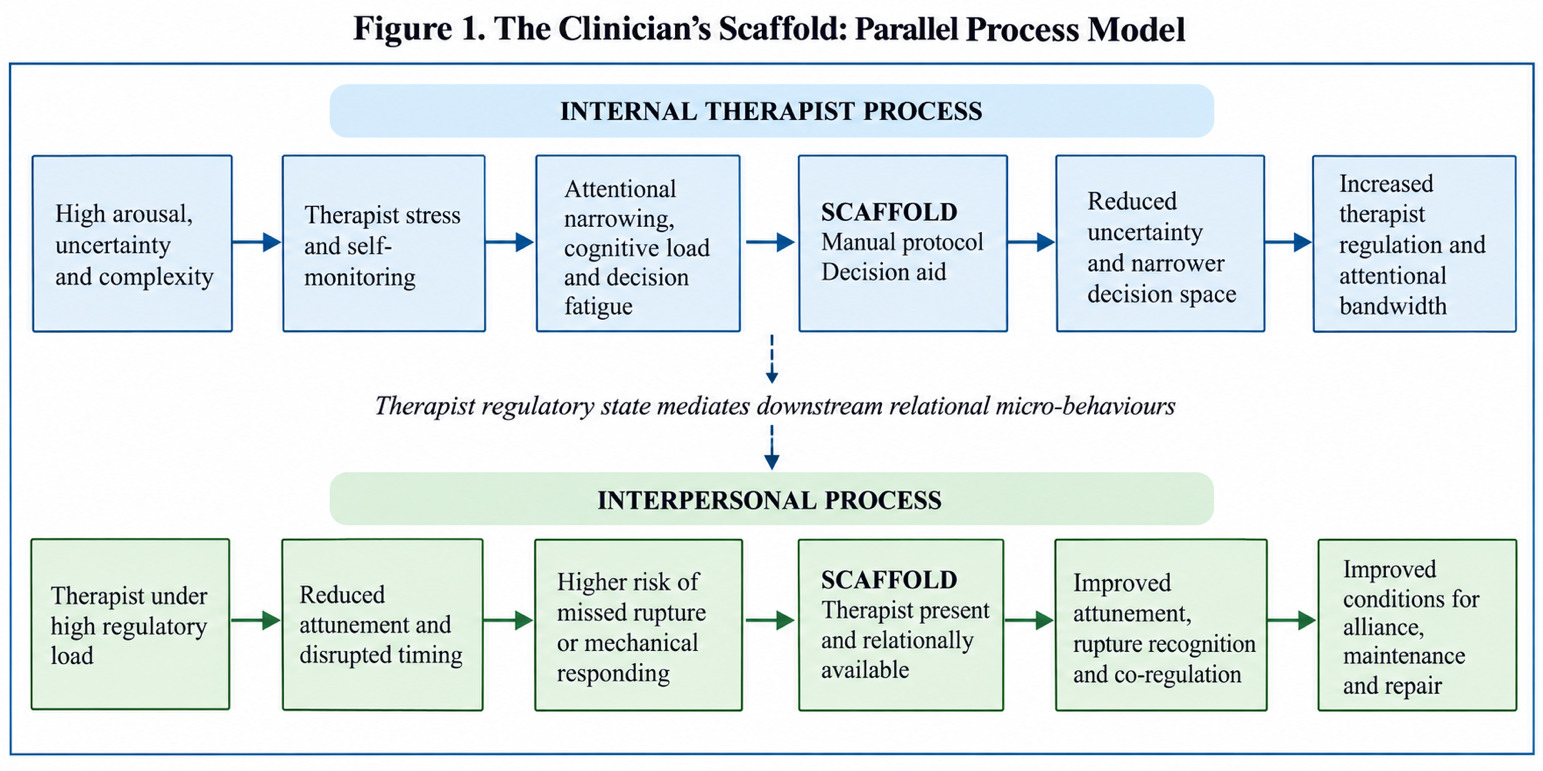
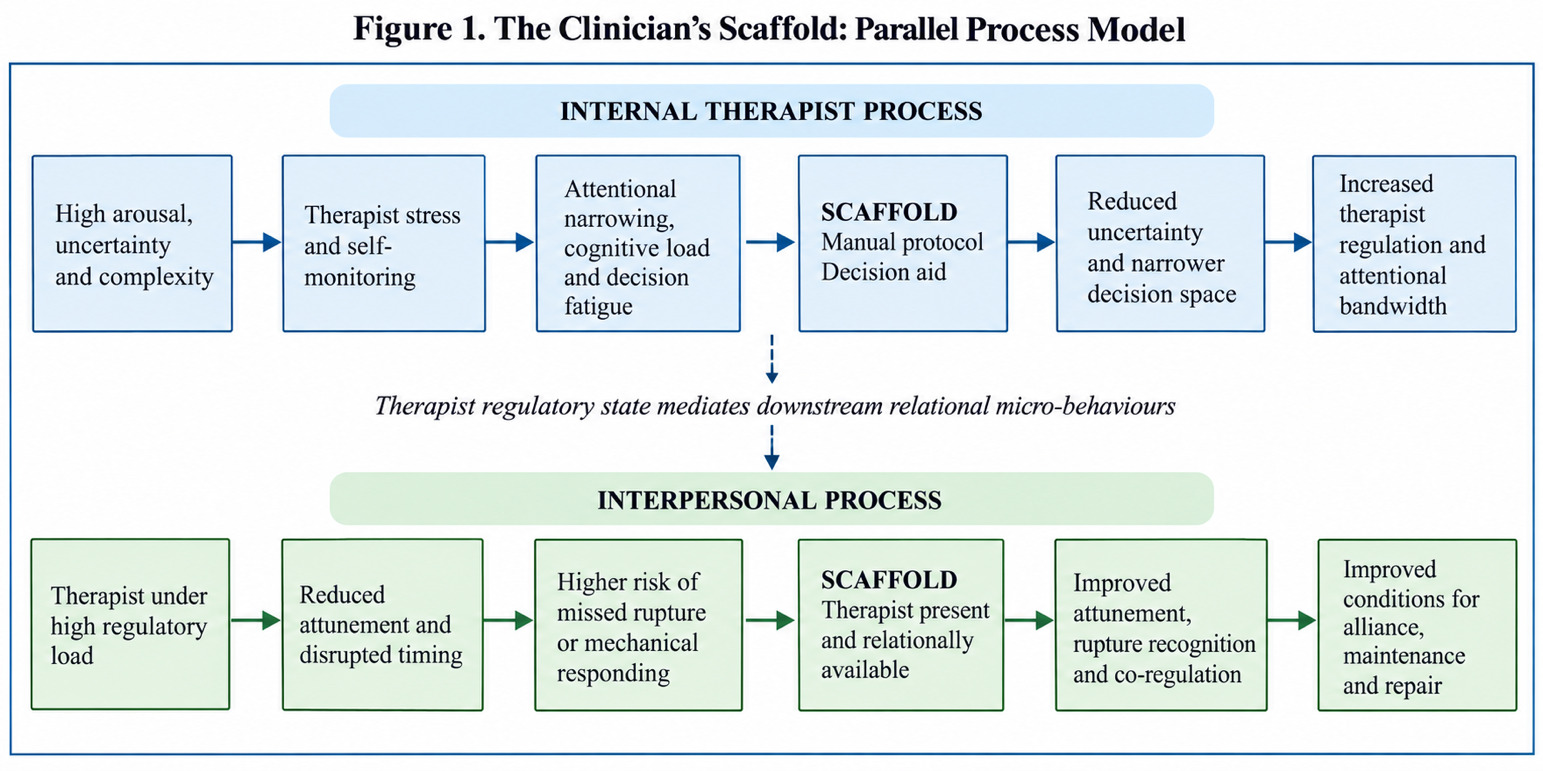
The proposed mechanism can be understood in three steps: high load constrains therapist attention; scaffold use reduces uncertainty and decision burden; and this state shift supports relational micro-behaviours. The central hypothesis of this model is that, rather than protocols directly regulating clients, they may first influence the clinician’s functioning under load. When therapists encounter high-arousal, high-uncertainty, or rupture-prone sessions, the demands placed on attention and self-regulation increase. Under such conditions, therapists may become more vulnerable to self-monitoring, performance anxiety, and state-dependent narrowing of attention, and they may experience corresponding costs regarding flexible judgement and relational responsiveness. The existing literature on stress, executive functioning, and attentional control supports the broader proposition that heightened stress constrains cognitive and affective flexibility, making it harder to sustain attuned interpersonal presence when demands rise (Arnsten, 2009; Derryberry & Reed, 1998).
In practical terms, this means that under high regulatory load, therapists may become more preoccupied with “doing it right”, risk management, or procedural correctness, while losing bandwidth for subtler relational tasks such as tracking shifts in affect, timing interventions, noticing rupture cues, or modulating prosody and pace. This is clinically consequential because therapeutic responsiveness depends not only on technical knowledge, but on the ability to hold multiple channels of information at once: the client’s words, affect, and implicit relational signals, and the therapist’s own internal state.
The clinician’s scaffold is hypothesised to interrupt this chain by lowering uncertainty and reducing decision burden in the moment. By providing an externally anchored next step, a scaffold narrows the active decision space and reduces the therapist’s burden of procedural problem-solving. Whether and how this occurs remain empirical questions.
The proposed effect is not merely cognitive efficiency in the abstract, but a shift in therapist state: reduced self-monitoring, reduced regulatory strain, and greater attentional bandwidth available for the interpersonal field. This logic is broadly consistent with the literature on cognitive load and decision-related self-regulatory depletion, which suggests that high task demands and repeated decision-making can impair subsequent control and flexibility (Sweller, 1988; Vohs et al., 2008).
This state shift is hypothesised to matter because relational micro-behaviours are highly sensitive to therapist load. Timing, facial affect, prosody, pacing, and rupture recognition are not separate from therapist regulation; they are among the ways regulation becomes visible within the therapeutic interaction. If scaffold use reduces the therapist’s internal load sufficiently, these micro-behaviours should become more available and more coherent. This provides one plausible pathway by which structured protocols may support co-regulation and alliance maintenance, particularly in sessions characterised by heightened affect, complexity, or uncertainty (Coan et al., 2006; Eubanks et al., 2018).
A complementary, testable framing is offered by neurovisceral integration models, which link autonomic regulation to attentional and affective control within an integrated regulatory network (Thayer & Lane, 2000). From this perspective, the scaffold does not replace clinical skill, formulation, or relational judgement. Rather, it supports the therapist’s ability to access these capacities under strain. The proposed mechanism can therefore be understood as state mediated: the scaffold acts first on therapist uncertainty and regulatory load, and through this change in therapist state, influences downstream relational processes such as attunement, rupture recognition, and repair.
The proposed mechanism can also be understood as a parallel process operating on two levels simultaneously. First, the scaffold acts on the therapist’s internal state by reducing uncertainty, cognitive load, and attentional narrowing under conditions of high arousal. Second, this shift in therapist state influences the interpersonal process by increasing the availability of relational micro-behaviours such as timing, prosody, responsiveness, and rupture recognition. In this model, the scaffold acts on more than treatment delivery; it acts first on the therapist, and through the therapist, on the therapeutic interaction. This parallel process is illustrated below in Figure 1.
This point is clinically important because alliance ruptures are common, and successful repair is associated with improved outcomes. A scaffold that stabilises therapist attention during high-arousal segments may therefore increase the likelihood of timely rupture recognition and repair, particularly for clinicians working in conditions of high uncertainty or with limited internal regulatory capacity under load (Eubanks et al., 2018).
A brief clinical illustration may clarify this mechanism. A trainee therapist is working with a client who presents with rapid, disorganised trauma material and escalating distress. The therapist notices their own attention narrowing: they are tracking risk, monitoring their own performance, and losing contact with the client’s moment-to-moment affect. They return to the grounding sequence outlined in the session protocol—a brief breathing exercise followed by a structured check-in. The external structure reduces uncertainty sufficiently for them to re-attend to the client’s face, notice a shift in breathing, and slow their own pace in response.
It should be emphasised that the mechanism proposed here is preliminary. The model draws on indirect evidence from adjacent bodies of literature—cognitive load, stress and attention, therapist development, and rupture–repair—rather than direct tests of the scaffold hypothesis itself. This indirectness is acknowledged as a limitation. The model is offered as a plausible candidate mechanism intended to generate testable predictions, not as a validated explanatory account. Future work will need to examine whether the proposed pathway—from scaffold use to reduced therapist load to improved relational micro-behaviours—holds under controlled conditions.
The Digital Counterargument
An important counterargument arises from the apparent effectiveness of digital and self-guided structured interventions, including online CBT programs and protocolised self-help tools delivered without a therapist. If structured therapies can benefit clients in the absence of a co-regulating clinician, then therapist regulation cannot be the sole mechanism by which such interventions exert their effects (Karyotaki et al., 2021; Mamukashvili-Delau et al., 2023; Tong et al., 2024).
This challenge is important because it places a limit on the present model. The clinician’s scaffold is not proposed as a universal explanation for why structured therapies work, nor as a replacement for direct client-facing accounts of mechanism. Structured interventions may plausibly benefit clients through multiple pathways, including psychoeducation, behavioural activation, exposure-based learning, cognitive rehearsal, and the general organising effects of structured therapeutic tasks.
However, the present model advances a complementary claim. In therapist-delivered treatment, structured protocols may exert an additional effect through therapist regulation—one that is absent in self-guided formats and may partly explain why guided interventions often outperform unguided ones under conditions of higher severity or complexity (Karyotaki et al., 2021; Tong et al., 2024). Thus, the question is not whether protocols work only through therapist regulation, but whether therapist regulation constitutes one overlooked component of their effectiveness in live clinical interaction and, additionally, whether this component has been misattributed to the protocol content itself.
Seen in this way, digital interventions do not refute the clinician’s scaffold model; rather, they help clarify its scope. Consequently, structured therapies may operate through both direct and therapist-mediated pathways, although the relative contribution of each may vary by delivery format. In therapist-delivered treatment, in which the clinician’s regulatory state directly shapes the therapeutic field, the scaffold pathway may account for a meaningful portion of what has traditionally been attributed to the intervention alone.
Alternative Explanations and Boundary Conditions
The clinician’s scaffold model is not intended to imply that the apparent benefits of structured protocols are explained solely by their regulatory function. Several alternative or complementary explanations warrant consideration.
First, apparent benefits of structured protocols may partly reflect organisational sorting. Services may be more likely to allocate structured protocols to lower-complexity or more manageable cases, thereby inflating their apparent effectiveness. Second, reverse causality is possible: therapists may turn to manuals because they are already anxious or uncertain, in which case protocol use may function as a marker of therapist state rather than its cause. Third, protocols may at times operate as defensive safety behaviours. In such cases, manual use may reduce therapist anxiety while simultaneously constraining flexibility and weakening genuine relational responsiveness. Fourth, observed benefits may partly reflect expectancy or allegiance effects, whereby manuals enhance clinician confidence, perceived legitimacy, or treatment coherence independently of any scaffold-specific attentional or regulatory mechanism (Munder et al., 2013).
These considerations do not invalidate the present model, but they do place important limits on its interpretation. The clinician’s scaffold is therefore offered as a candidate mechanism rather than a complete explanatory account. Its contribution lies in specifying one plausible pathway by which structure may support therapist functioning under load: by reducing uncertainty and decision burden sufficiently to preserve attentional bandwidth and relational micro-behaviours. Future empirical work should therefore examine whether scaffold-related effects remain when expectancy, allegiance, therapist experience, case complexity, and organisational allocation patterns are considered.
Testable Propositions
The clinician’s scaffold model generates a number of testable propositions regarding the role of therapist regulation in mediating the effects of structured protocols. These are intended as guiding hypotheses rather than fixed methodological prescriptions and are offered to support empirical investigation of the proposed mechanism.
Proposition 1: State-Mediated Pathway
The primary prediction is that the effects of scaffold use on relational process variables will be mediated by therapist state. More specifically, scaffold use is hypothesised to reduce therapist uncertainty and regulatory load, which in turn increases attentional bandwidth and relational availability.
This proposition could be examined using mediation designs in which scaffold presence or use is treated as the independent variable, therapist state (e.g., perceived load, regulation, or self-monitoring) as the mediator, and relational process variables (e.g., attunement, responsiveness, rupture recognition) as the outcomes. Therapist state may be indexed through self-report measures of perceived cognitive load or stress, behavioural indicators such as response latency or speech disruption, or physiological proxies where feasible.
Proposition 2: Moderation by Expertise
The regulatory function of scaffolds is expected to vary by clinician experience. Scaffolds may provide greater regulatory benefit for less experienced therapists, who are more reliant on external structure under conditions of uncertainty, whereas more experienced clinicians may draw more readily on internalised frameworks. This proposition could be tested through moderation analyses comparing the effects of scaffold use across levels of therapist experience or training stage.
Proposition 3: Moderation by Regulatory Load
The effects of scaffold use are expected to be strongest under conditions of high regulatory load, such as sessions involving high emotional intensity, interpersonal rupture, or clinical complexity. Under low-load conditions, scaffold effects may be minimal or negligible. Regulatory load may be operationalised using session-level indicators such as therapist-rated perceived difficulty, observer-rated session intensity or complexity, or the presence of rupture events or affective escalation.
Proposition 4: Curvilinear Effects of Structure
The model predicts a non-linear relationship between scaffold use and relational functioning. Moderate scaffold use may support therapist regulation and relational availability, whereas excessive or rigid use may constrain flexibility and reduce attunement. This proposition could be examined using curvilinear models, for example by testing whether both low and high levels of structure are associated with poorer relational process variables than are moderate levels.
Proposition 5: Synchrony and Micro-Process Markers
If scaffold use supports therapist regulation, this should be observable at the level of relational micro-processes, including timing, prosody, affective coordination, and rupture–repair sequences. These processes could be assessed using observational coding systems, session-level process measures, or synchrony-based indices such as behavioural or physiological coordination, where available.
Summary
Taken together, these propositions frame the clinician’s scaffold as a state-mediated mechanism rather than a purely technique-driven effect. The emphasis is not on whether protocols are used, but on how their use shapes therapist functioning under load and how this, in turn, influences relational processes within therapy.
Limitations
This article presents a conceptual synthesis and does not directly test the proposed mechanism. Although the model offers initial definitions and illustrative measurement approaches for core constructs such as therapist state, regulatory load, and perceived containment by the scaffold, these constructs will require further refinement and validation in empirical work. The model may also function differently across treatment settings, clinician developmental stages, levels of protocol rigidity, and modes of delivery. Future qualitative research could usefully examine clinicians’ lived experience of in-session scaffold use, particularly how therapists describe shifts in perceived containment, attentional load, and relational availability under conditions of uncertainty. Accordingly, the present account should be understood as a formative, theory-building contribution. The model is intentionally exploratory: it aims to articulate a plausible mechanism in sufficient detail to invite critique, refinement, and empirical testing, rather than to provide a settled or complete explanatory account. Future iterations may substantially revise the proposed pathway as evidence accumulates.
Conclusion
This article reframes manualised protocols and structured decision aids as more than vehicles for fidelity and evidence translation. The clinician’s scaffold model proposes that protocols can serve a regulatory function by stabilising the therapist’s attention under load, reducing uncertainty and choice overload, and increasing the likelihood that relational micro-behaviours—timing, prosody, facial affect, and rupture–repair—remain available during high-arousal moments. On this account, in therapist-delivered settings, protocols shape outcomes not only through what is delivered but also through the state from which clinicians deliver: a state that supports co-regulation, flexibility, and responsiveness rather than self-monitoring and mechanical correctness.
Several practical implications follow. First, training can explicitly teach clinicians to use protocols as state supports rather than scripts: a scaffold should be selected and applied with attention to its regulatory function (“Does this structure reduce uncertainty right now?”). Second, supervision can incorporate a dual focus: technical decision-making and therapist state under load. Supervisors may help clinicians identify when protocol use is stabilising (increasing attunement and repair capacity) versus when it becomes defensive (reducing relational risk-taking and flattening responsiveness). Third, implementation efforts may benefit from measuring beyond adherence and competence to record therapist stress markers and rupture–repair processes, particularly in early-career clinicians or high-intensity settings.
The model also invites empirical work. The proposed predictions generate testable pathways: (a) mediation via therapist stress and rupture–repair, (b) moderation by clinician expertise, (c) curvilinear effects in which rigidity undermines outcomes, and (d) physiological synchrony as a candidate marker of co-regulation when clinicians feel “held” by a scaffold. If supported, these findings would strengthen the case for therapist self-regulation under load as a trainable clinical competency and would position structured protocols as one practical route for supporting it.
In summary, the clinician’s scaffold offers a preliminary, mechanism-level account for why structure may sometimes increase the level of humanity present in the room: by lowering uncertainty sufficiently that the therapist can remain present. Whether this account withstands empirical scrutiny remains to be seen.
Declaration of Generative AI and AI-Assisted Technologies in the Writing Process
AI tools were used for language editing and to generate alternative phrasing during revision. The theoretical model, constructs, and clinical interpretations are the author’s original work. The author reviewed and substantively revised all text and takes full responsibility for the manuscript.